





The Israel-Hamas war has the potential to disrupt oil supply in the Middle East region, leading to a rally in prices for the energy source that can impact other commodities, worsening global food insecurity, the World Bank said in a report released this week.
The Israel-Hamas war comes on the heels of the biggest shock to commodity markets since the 1970s — Russia’s war with Ukraine, Indermit Gill, the World Bank’s chief economist and senior vice president for Development Economics, said in a press release. If the latest conflict in the Middle East were to escalate, the “global economy would face a dual energy shock for the first time in decades — not just from the war in Ukraine but also from the Middle East.”
Gill’s colleague, the World Bank’s Deputy Chief Economist and Director of the Prospects Group Ayhan Kose warned that higher oil prices, if sustained, “inevitably mean higher food prices.”
So far, however, the conflict has had only modest impacts on commodity prices, which the World Bank believes may be due to the global economy’s ability to absorb oil-price shocks.
On Tuesday, U.S. benchmark West Texas Intermediate crude
CL.1,
CLZ23,
saw its December contract settle at $81.02 a barrel on the New York Mercantile Exchange, down from the $82.79 settlement for front-month prices on Oct. 6, the day before the Hamas attack on Israel. On its expiration day, global benchmark Brent crude for December delivery
BRNZ23
ended at $87.41 on ICE Futures Europe, less than $3 above the $84.58 Oct. 6 settlement.
Market changes
Current oil-market conditions “differ markedly” from energy crisis of the 1970s, which saw energy prices skyrocket following an embargo by Arab oil producers, and supply declines in the wake of the Iranian revolution, the World Bank said.
“The global economy is less reliant on oil; there is a more diversified base of oil suppliers; several countries have strategic stocks of oil; futures markets help price discovery and hedging; and the [International Energy Agency] helps formulate responses to energy price shocks,” it said.
Oil intensity, the amount of oil needed to produce one unit of gross domestic product, has declined over the last 50-plus years amid efficiency improvements in the transport sector and substitution of other energy sources for oil, the World Bank said.
Oil supplies now come from many sources, including Mexico, Alaska, U.S. shale oil, Canadian oil sands, and biofuels — instead of relying heavily on a few producers, particularly those in the Middle East, it said.
Several large oil-importing countries have also set up strategic oil reserves for emergency use, it said. The IEA, meanwhile, plays a key role in the market, including establishing rules on reducing its members’ reliance on oil.
Scenarios
So far, the modest impact of the latest conflict in the Middle East on energy markets is “consistent with the baseline forecasts” presented in the World Bank report.
Under the baseline, oil prices are projected to average $90 a barrel in the fourth quarter of this year, and $84 in 2023 as a whole, down from $100 in 2022, it said. Oil production cuts by the Organization of the Petroleum Exporting Countries and their allies are expected to be in place to the end of this year, mostly offsetting supply increases from other sources.
As output cuts by OPEC+ are removed and global activity slows, oil prices are then expected to edge down to an average of $81 in 2024, it said.
In the event of a “small disruption” to global oil supply from the Middle East conflict, where global oil supply is reduced by 500,000 barrels to 2 million barrels a day, oil prices would initially increase by 3% to 13%, or $3 to $12 a barrel, above the 2023 fourth quarter baseline forecast of $90, the World Bank said.
Under a “medium” disruption, of between 3 million to 5 million barrels a day, oil prices would initially increase by about 21% to 35%, or $19 to $31 a barrel, above the baseline forecast, it said. And under a “large” disruption scenario, where global supply falls by 6 million to 8 million barrels a day, oil prices would initially increase by 56% to 75%, or $50 to $67 a barrel, above the baseline forecast.
‘Cascading’ effects
The World Bank points out that the risk scenarios for oil also present “potentially significant near-term implications” for other commodity prices.
“Supply disruptions affect other commodities mainly through higher energy prices, which raise production costs of food and metals,” it said. “By increasing global uncertainty, the conflict could also raise the price of gold
GC00,
often considered a safe haven asset.”
Disruptions to energy markets can raise production costs of energy-intensive metals such as aluminum and zinc , as well as transportation costs for minerals such as iron ore, it said.
A sustained oil price spike would raise food prices as it increases production and transportation costs for food and fertilizers — and fertilizer prices could also climb if prices for natural gas
NG00,
and coal were to rise, the report said. Natural gas is a key power source to produce fertilizer.
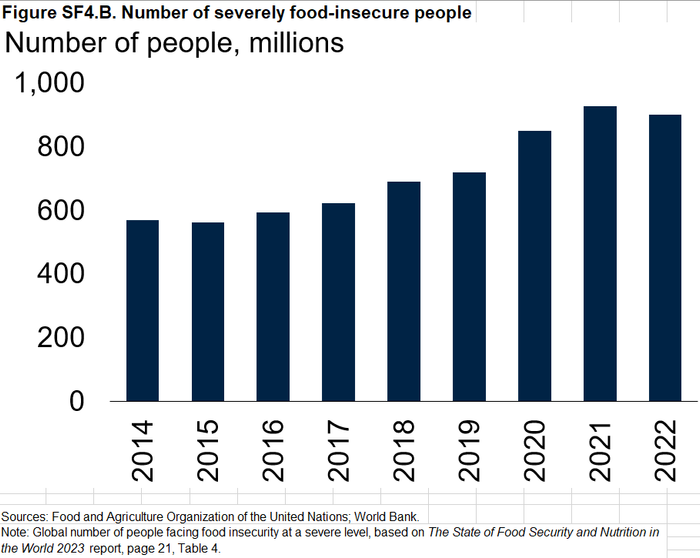
If food prices were to increase, global food insecurity, which is already on the rise, “could reach new heights,” the World Bank said, noting that the Food and Agriculture Organization of the United Nations reported that the global number of severely food-insecure people rose to an estimated 900 million in 2022, from 624 million in 2017.
While the global economy is now in a “better position to cope with energy price shocks, than in previous decades,” the latest conflict also comes on the heels of another geopolitical disruption –- Russia’s invasion of Ukraine in early 2022, it said.
““The continuation and escalation of either or both conflicts would raise the specter of duel and compounding shocks to commodity markets that could test the resilience of the already fragile global economy.””
“The continuation and escalation of either or both conflicts would raise the specter of duel and compounding shocks to commodity markets that could test the resilience of the already fragile global economy,” the World Bank said.
Read the full article here