




By Chen Aizhu
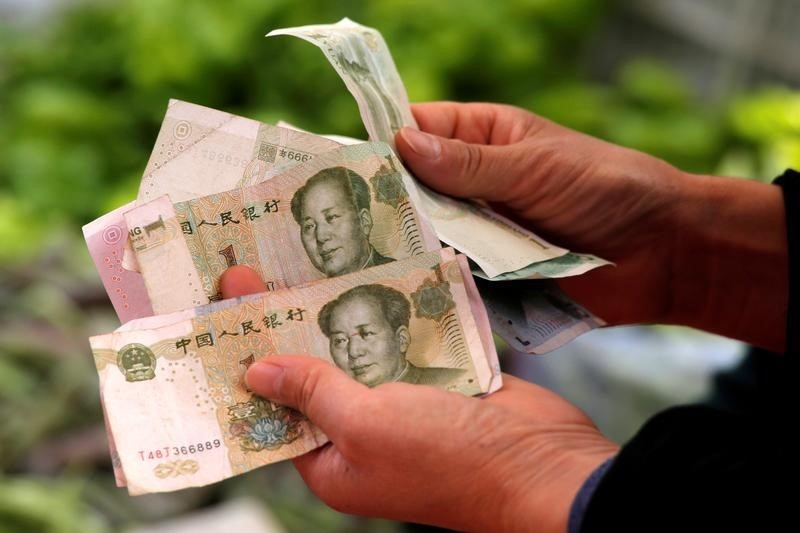
SINGAPORE (Reuters) – China has dramatically increased use of the yuan to buy Russian commodities over the past year, with nearly all of its purchases of oil, coal and some metals from its neighbour now settled in the Chinese currency instead of dollars, multiple trading executives with direct knowledge of the matter told Reuters.
The switch to yuan to pay for much of a roughly $88 billion commodities trade in the wake of the Ukraine war accelerates China’s efforts to internationalise its currency, at the expense of the dollar, although strict capital controls are expected to limit its global role in the near term.
In March, the yuan – also known as the renminbi – became the most widely-used currency for cross-border transactions in China, overtaking the dollar for the first time, official data showed, although its share as a global payments currency remains small at 2.5%, according to SWIFT, compared with 39.4% for the dollar and 35.8% for the euro.
Chi Lo, senior investment strategist at BNP Paribas (OTC:) Asset Management in Hong Kong, predicts a long-term “snowball effect” as more countries join the ” bloc” to reduce risks of dollar exposure, “especially after they’ve seen what the U.S.-led sanctions against Russia have done,” he said.
“This is a very long term development stretching into the coming one or two, even three decades,” he said.
“For now, and for the foreseeable next few years, I think the trade using RMB will predominantly be used for commodity and energy trade.”
Despite Beijing’s push beginning over a decade ago to internationalise the yuan, the currency had only been used sporadically in big Chinese commodities purchases given that most global trading of oil, gas, and coal is priced off dollar-based benchmarks.
That began changing last year as western buyers shunned purchases of Russian goods in the face of mounting sanctions following Moscow’s invasion of Ukraine. Chinese buyers stepped in to snap up discounted , coal and aluminium, boosting 2022 commodities imports from Moscow by 52% in value terms.
That helped save China billions of dollars as its economy reeled from COVID lockdowns, with purchases poised to grow this year as China’s economy recovers.
Total settlements on Cross-Border Interbank Payment System (CIPS), China’s alternative to the SWIFT international payment system, rose 21.5% year-on-year to 96.7 trillion yuan ($14.02 trillion) in 2022, Chinese central bank data showed.
Nearly all of China’s oil imports from Russia, mostly crude but also smaller volumes of fuel oil, are now settled in yuan, five trading executives with direct knowledge of the matter told Reuters. China imported a combined $60.3 billion worth of crude oil and fuel oil from Russia last year, according to Chinese customs.
None of the executives wanted to be identified given the sensitivity of the matter.
The People’s Bank of China did not immediately respond to a request for comment.
Globally, yuan use has been gaining momentum. Argentina last month said it will start paying for Chinese imports in yuan to ease pressure on its dollar reserves, while in March France’s TotalEnergies sold China the first yuan-settled LNG cargo.
(Graphic: China’s oil, commodities imports from Russia, https://fingfx.thomsonreuters.com/gfx/ce/zjpqjmnkovx/China%20imports%20of%20Russian%20commodities.jpg)
The shift began in April 2022, after key Russian banks were removed from SWIFT following Russia’s Feb. 24 invasion of Ukraine, which Moscow calls a special military operation.
Initially, some of the Chinese buyers struggled to obtain trade financing in dollars as banks banned the business, forcing the use of telegraphic transfer – equivalent to cash pre-payment – which posed a challenge in particular to cash-strapped independent refiners, traders said.
Yuan settlement surged after the U.S.-imposed import ban and as Europe stepped up restrictions on Russian exporters before eventually slapping a trade embargo, with a Western price cap imposed on Dec. 5 on Russian crude exports.
“All seaborne Russian oil sales to China are now settled in renminbi since the price cap, sidelining the last small number of banks that were handling U.S. dollars,” said one trading executive.
“It becomes tremendously complicated dealing in USD under the price cap regime. It means a lot more compliance work for the banks,” the person said.
China opposes unilateral sanctions but is also wary of itself being exposed to so-called secondary sanctions.
The share of yuan in Russia’s import settlements in 2022 jumped to 23% from 4%, Russia’s central bank said in March.
(Graphic: Russian oil transactions flows into China after the Ukraine war, https://fingfx.thomsonreuters.com/gfx/ce/akveqrgmovr/Russian%20oil%20transaction%20flow%20after%20war.jpg)
Last month, Russian Deputy Prime Minister Alexander Novak said that Moscow will continue to accept more payments for energy exports in roubles and yuan as it seeks to move away from the dollar and euro.
Russian President Vladimir Putin has said that two-thirds of trade between Beijing and Moscow is now settled in roubles or yuan.
Surging commodity imports pushed China’s trade deficit with Russia to $38 billion last year, although the gap has narrowed in the first four months of 2023.
HICCUPS
The transition to yuan payments has not always been smooth.
State energy giant CNPC was worried for months last year that its piped gas imports from Russia’s Gazprom (MCX:) could be cut as Chinese lenders ICBC and Bank of China, fearful of secondary sanctions, looked to exit the business, said a senior source who closely follows the trade.
ICBC and Bank of China didn’t respond to requests for comment.
For nearly half a year CNPC was unable to pay Gazprom in dollars, before Bank of Communications took over and shifted to pay in renminbi, the source said.
Bank of Communications and CNPC declined comment.
Gazprom, which said last September it had agreed with CNPC to settle gas trade in roubles and yuan, did not respond to requests for comment.
Gazprom official Alexei Konivetsky said in September that the company had faced a disruption in payments from China as “numerous Chinese banks are afraid of secondary sanctions while working with us.”
(Graphic: Russian oil transaction flows into China before Ukraine war, https://fingfx.thomsonreuters.com/gfx/ce/zgpobewkkvd/Russian%20oil%20transaction%20flow%20before%20war.jpg)
For related story and FACTBOX, please click on these links; [L4N3771LF]
($1 = 6.8978 renminbi)
Read the full article here