




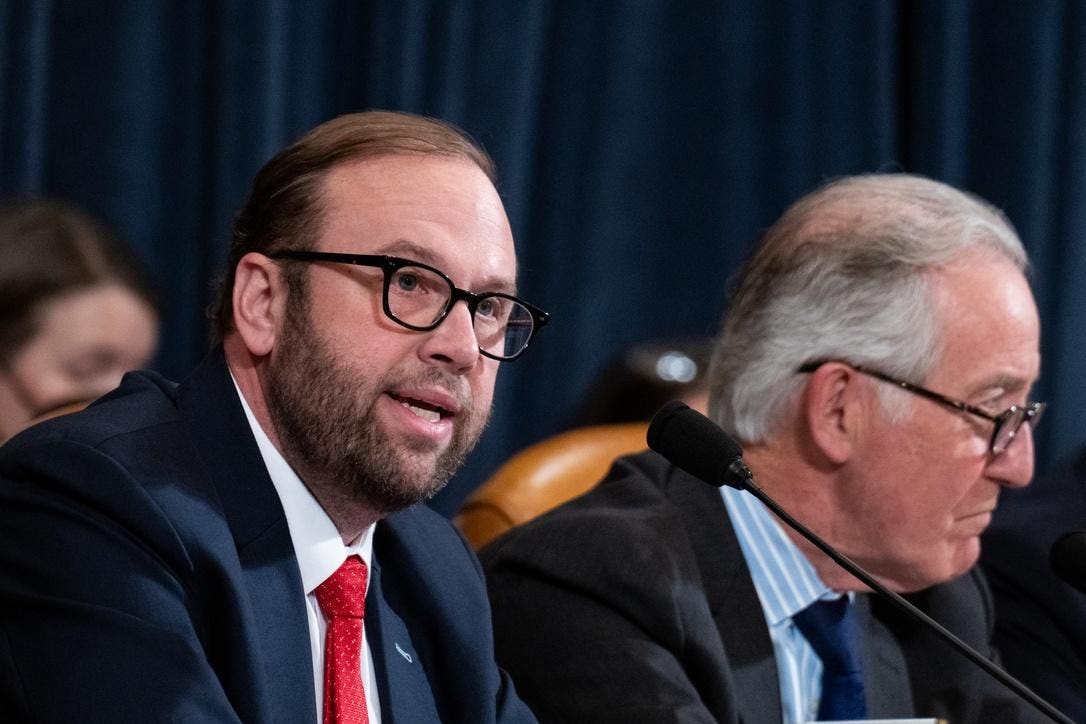
House Ways and Means Committee Chairman Jason Smith (R-MO) and Oversight Subcommittee Chairman David Schweikert (R-AZ) announced they are looking into political abuses by non-profit organizations. The lawmakers said their initiative could lead to legislation aimed at stopping the use of tax-exempt dollars to fund explicitly political activities.
Their effort creates a small glimmer of hope that Congress could clean up this growing scandal in a bipartisan way. For years, Senate Finance Committee Chair Ron Wyden (D-OR) has pushed for more curbs and transparency for these organizations. And in 2021, progressive senators Sheldon Whitehouse (D-RI) and Elizabeth Warren (D-MA) urged the Treasury to require more disclosure of who gives to these groups, though the department has taken no action.
The good news: If Republicans are outraged by what they see as Democratic abuses and Democrats are offended by perceived GOP abuses, maybe there is a bipartisan opportunity to fix the system.
The bad news: Smith and Schweikert focus their concerns entirely on activities that benefit Democrats and ignore parallel efforts to assist Republican candidates.
Rewriting History
And they do more than a little rewriting of history when they say, “The expansion of politics into almost all aspects of life means that activities that were previously considered nonpartisan have been made partisan—legislation and regulation have not kept up.”
In fact, abuses have been going on for decades. They took off after the US Supreme Court’s 2010 ruling in Citizen’s United v. FEC that opened the door to unlimited, secret campaign contributions. And they got a second boost in 2018, when the Trump Administration scrapped most remaining donor disclosure requirements for tax-exempts, though the IRS did little to monitor the groups even before that.
At issue is the role that 501(c)(3) and 501(c)(4) non-profits play in politics. (c)(3)’s are not supposed to be involved in partisan politics at all. The rules for (c)(4) social welfare organizations are murkier. Regulations appear to prohibit their participation in electoral politics. But for decades the IRS has looked the other way as long as politics is not their “primary purpose,” though no one knows exactly what that means either. To see just how long the IRS has been struggling with the issue, read this paper from 1995.
The big problem isn’t the tax-exemption itself. Donors can’t deduct contributions to (c)(4)’s and most political organizations spend everything they take in, so they’d owe no tax in any event. One exception: A few are bringing in so much money they are starting to earn tax-free interest.
Dark Money
The real benefits: While the amount an individual can give directly to a campaign is limited, a single donor can contribute unlimited dollars to political Super PACs. And one way these fat cat benefactors can hide their identities is by funneling political money through (c)(4)s.
Since Citizen’s United, big donors increasingly have used a two-step process to do it.
First, they give unlimited funds to dark money (c)(4)’s, which don’t have to disclose the names of their donors. Then, the (c)(4)s pump big bucks into Super PACs, expenditure-only political committees that are supposed to be independent of campaigns but often are not. And the Super PACs don’t have to report the names of donors to the (c)(4)s either.
Here is a particularly egregious example: A tax-exempt called Leadership Action Fund was created on June 22, 2022. In July, a Super PAC was created to support the Oklahoma Senate campaign of a GOP candidate named TW Shannon. According to a complaint by a campaign watchdog group, the tax-exempt, which allegedly reported no charitable activities, contributed more than $620,000 to the Super PAC by Aug 2 on behalf of “unknown persons.”
Alleged Abuses
For their part, Smith and Schweikert pointed to three examples of abuses, mostly focused on (c)(3)’s and all allegedly benefiting Democrats:
· Efforts by a Democratic Super PAC called Mind The Gap to encourage donations to 501(c)(3) groups that boost voter registration among likely Democratic voters.
· Gifts of several hundred million dollars by Meta CEO Mark Zuckerberg and his wife Priscilla Chan to help fund two (c)(3) organizations to “promote safe and reliable voting in states and localities during the COVID-19 pandemic.” Smith and Schweikert claim those groups focused their work in Democratic-leaning areas.
· A $208 million donation by Swiss billionaire Hansjörg Wyss to three nonprofits that in turn funded progressive causes. The GOP lawmakers said the funds were channeled through a (c)(3) and a related (c)(4). Foreign nationals are barred from contributing directly or indirectly to US political campaigns.
But the two lawmakers are, unsurprisingly, ignoring egregious abuses by Republican benefactors (see here and here). And whichever side of the aisle, politics may be the least charitable enterprise imaginable. Tax-exempts have no business bankrolling politicians, directly or indirectly.
Congress should limit the tax exemption to public charities, with full donor disclosure. Or, at the very least, it should prohibit direct or indirect campaign activities by tax-exempts and strictly limit their advocacy role. Social welfare groups have an absolute First Amendment right to say what they want about politics. But they don’t have a right to a tax exemption to do it.
Read the full article here