




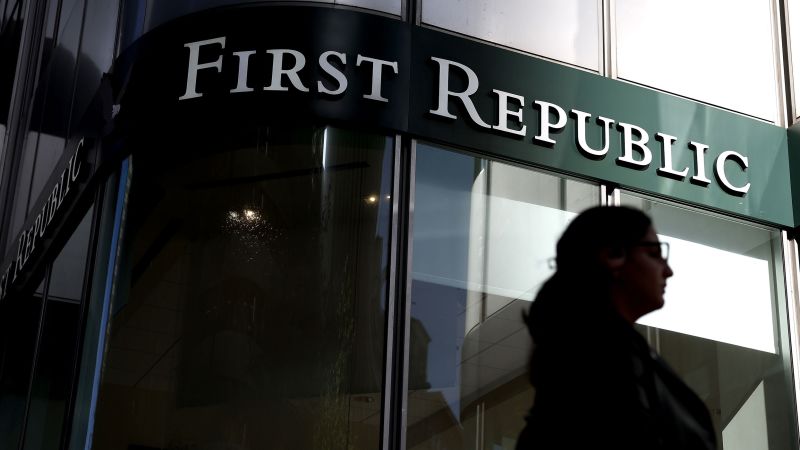
To some, the question of where to keep your money safe might seem obvious — go with one of the big guys, the banks that have been deemed “too big to fail.” Their ATMs and branches are ubiquitous, their mobile apps sleek and user-friendly.
That’s a perfectly rational decision for most people who just need a place to deposit their paychecks and occasionally withdraw cash to pay the dog walker.
But those mega-banks lack the dexterity and regional specialization that small businesses crave, which is partly why Corporate America and policy makers alike are worried about the continued turmoil among regional banks.
In just two months, a spark of panic has turned into a conflagration that has put America’s regional banks on notice. Already, three lenders — First Republic, Silicon Valley Bank and Signature — have failed. (They represent the second-, third- and fourth-largest bank failures in US history.)
This week, Wall Street turned its focus to PacWest, another similarly midsize, West Coast regional, after it revealed customers pulled 9.5% of its total deposits after First Republic failed on May 1.
All of those banks share a status in common as a “regional” or “sector-specific” lender. The differences between them and the too-big-to-fail variety boil down to a lot more than just size.
Big banks like JPMorgan Chase, Citi, Bank of America or Wells Fargo are sort of “one size fits all” financial conglomerates, says Robert Hockett, a law professor and expert on public finance at Cornell University. “They basically tend to turn everything into securities trading.”
These banks are sometimes known as “G-SIBs,” or “global systemically important banks.”
As such, they are typically much more interested in investing abroad and in global capital markets than they are in domestic production, Hockett says.
Small businesses, which employ roughly half of private-sector workers in America, overwhelmingly prefer to bank with small or midsize lenders because they prefer the customer service.
Regional and small banks also tend to develop expertise that businesses rely on.
Take Silicon Valley Bank, the go-to tech startup lender in the Bay Area before it was felled by a frenzied bank run on March 10. Despite what Hockett described as “boneheaded” managerial mistakes, the bank’s core business — providing financing for new companies that wouldn’t get the time of day from a larger national bank — is exactly the kind of activity policy makers want to encourage.
“They were classic investors of what we sometimes call ‘patient’ capital, which is to say they made money available to startups even when those startups did not promise any profits until three or four years down the line,” Hockett said.
That specialization, ironically, is now part of the dilemma facing banks.
By definition, regional banks are more specialized and focused. In other words, they are less diverse in their holdings, which is partly why so many of them have loaded up on US Treasuries — “the most boring of all possible investments,” Hockett says.
Those boring, extremely safe assets have lost value as result of the Federal Reserve’s aggressive yearlong interest-rate hikes, leaving dozens of banks sitting on a mountain of unrealized losses.
Those paper losses aren’t a problem unless all your customers suddenly want their money and you have to sell off assets to get cash. In SVB’s case, because most of their customers held deposits above the $250,000 limit for FDIC insurance, the bank run proved fatal.
Hockett and others argue that it’s time to scrap, or at least lift, the $250,000 limit on deposit insurance, and thereby stop the panic that causes depositors to flee.
That idea got an extra boost earlier this month, when the FDIC itself released a report advocating for an increase in the deposit insurance limit for business payment accounts. Lawmakers in DC have reportedly been in talks to raise the cap, though it’s not clear whether Congress will act.
Without raising the cap, Hockett argues, we risk letting the Wall Street banks gobble up their smaller competition when those regional lenders fail. After all, JPMorgan — which became America’s largest bank after absorbing Washington Mutual and Bear Stearns in the 2008 financial crisis — was able to grow even larger after agreeing to buy up the bulk of First Republic’s assets on the cheap.
“Unfortunately, I think what we’re doing now is essentially confronting the startups of the future with a sort of Hobson’s choice,” Hockett says. “We can say, ‘OK, you can keep banking with sector-specific banks that sort of specialize in your particular industry and that are good at understanding your needs and your risks and your vulnerabilities and the like. But if you do that, then there’s the possibility that you’ll lose your transaction accounts because they’re not insured above a quarter million dollars.”
The other choice: Play it safe by putting all of your money in a one-size-fits-all Wall Street institution like JPMorgan Chase and miss out on the expertise.
“There’s no way that we’ll be able to finance production and startups and small businesses in every region of the country if the only banks we have are a few gigantic banks located either in Wall Street or San Francisco,” Hockett said.
Read the full article here