




In 1839, German scientist Gustav Rose went prospecting in the Ural Mountains and discovered a dark, shiny mineral. He named the calcium titanate “perovskite” after Russian mineralogist Lev Perovski. The mineral was one of many that Rose identified for science, but nearly two centuries later, materials sharing perovskite’s crystal structure could transform sustainable energy and the race against climate change by significantly boosting the efficiency of commercial solar panels.
Solar panels accounted for nearly 5% of U.S. energy production last year, up almost 11-fold from 10 years ago and enough to power about 25 million households. It’s the fastest-growing source of new power, too, accounting for 50% of all new electricity generation added in 2022. But nearly all of the solar modules that are used in power generation today consist of conventional silicon-based panels made in China, a technology that has changed little since silicon cells were discovered in the 1950s.
Other materials used, like gallium arsenide, copper indium gallium selenide and cadmium telluride — the latter a key to the largest U.S. solar company First Solar‘s growth — can be very expensive or toxic. Backers of perovskite-based solar cells say they can outperform silicon in at least two ways and accelerate efforts in the race to fight climate change. Just this week, First Solar announced the acquisition of European perovskite technology player Evolar.
The silicon limits of solar cells
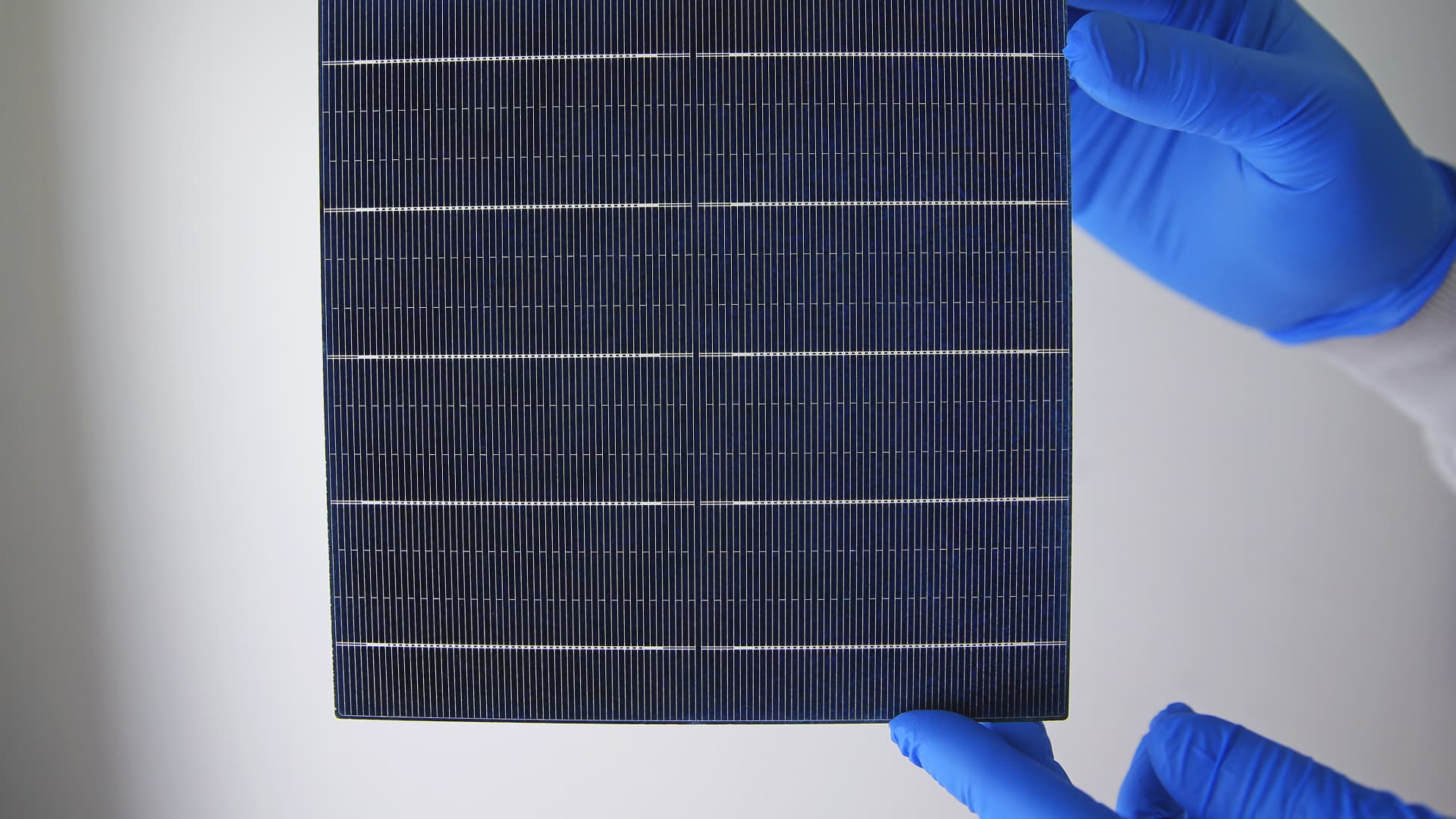
Photovoltaic cells convert photons in sunlight into electricity. But not all photons are the same. They have different amounts of energy and correspond to different wavelengths in the solar spectrum. Cells made of perovskites, which refer to various materials with crystal structures resembling that of the mineral, have a higher absorption coefficient, meaning they can grab a wider range of photon energies over the sunlight spectrum to deliver more energy. While standard commercial silicon cells have efficiencies of about 21%, laboratory perovskite cells have efficiencies of up to 25.7% for those based on perovskite alone, and as much as 31.25% for those that are combined with silicon in a so-called tandem cell. Meanwhile, even as silicon efficiencies have increased, single-junction cells face a theoretical maximum efficiency barrier of 29%, known as the Shockley-Queisser limit; their practical limit is as low as 24%.
Furthermore, perovskite cells can be more sustainable to produce than silicon. Intense heat and large amounts of energy are needed to remove impurities from silicon, and that produces a lot of carbon emissions. It also has to be relatively thick to work. Perovskite cells are very thin — less than 1 micrometer — and can be painted or sprayed on surfaces, making them relatively cheap to produce. A 2020 Stanford University analysis of an experimental production method estimated that perovskite modules could be made for only 25 cents per square foot, compared to about $2.50 for the silicon equivalent.
“Industries will set up production lines in factories for commercialization of their solar cells before 2025,” says Toin University of Yokohama engineering professor Tsutomu Miyasaka, who reported the creation of the first perovskite solar cell in 2009. “Not only for use in outdoor solar panels but also indoor IoT power devices, which will be a big market for perovskite photovoltaic devices because they can work even under weak illumination.”
Backing next-generation climate technology
Companies around the world are starting to commercialize perovskite panels. CubicPV, based in Massachusetts and Texas, has been developing tandem modules since 2019, and its backers include Bill Gates’ Breakthrough Energy Ventures. The company says its modules are formed of a bottom silicon layer and a top perovskite layer and their efficiency will reach 30%. Their advantage, according to CEO Frank van Mierlo, is the company’s perovskite chemistry and its low-cost manufacturing method for the silicon layer that makes the tandem approach economical.
Last month, the Department of Energy announced that CubicPV will be the lead industry participant in a new Massachusetts Institute of Technology research center that will harness automation and AI to optimize the production of tandem panels. Meanwhile, CubicPV is set to decide on the location of a new 10GW silicon wafer plant in the U.S., a move it says will speed tandem development.
“Tandem extracts more power from the sun, making every solar installation more powerful and accelerating the world’s ability to curb the worst impacts of climate change,” said Van Mierlo. “We believe that in the next decade, the entire industry will switch to tandem.”
In Europe, Oxford PV is also planning to start making tandem modules. A spinoff from Oxford University, it claims a 28% efficiency for tandems and says it’s developing a multi-layered cell with 37% efficiency. The company is building a solar cell factory in Brandenburg, Germany, but it has been delayed by the coronavirus pandemic and supply-chain snags. Still, the startup, founded in 2010 and backed by Norwegian energy company Equinor, Chinese wind turbine maker Goldwind and the European Investment Bank, is hopeful it can start shipments this year pending regulatory certification. The technology would initially be priced higher than conventional silicon cells because tandem offers higher energy density but the company says the economics are favorable over the full lifetime of usage.
Many solar upstarts over the years have attempted to break the market share of China and conventional silicon panels, such as the notoriously now bankrupt Solyndra, which used copper indium gallium selenide. First Solar’s cadmium telluride thin film approach survived a decade-long solar shakeout because of its balance between low-cost relative to crystalline silicon and efficiency. But it now sees tandem cells as a key to the solar industry’s future, too.
“Perovskite is a disruptive material without disrupting the business model — the entrenched capacity to manufacture based on silicon,” says Oxford PV CTO Chris Case. “Our product will be better at producing lower-cost energy than any competing solar technology.”
Caelux, a California Institute of Technology spinoff, is also focused on commercializing tandem cells. Backed by VC Vinod Khosla and Indian energy, telecom and retail conglomerate Reliance Industries, Caelux wants to work with existing silicon module companies by adding a layer of perovskite glass to conventional modules to increase efficiency by 30% or more.
Questions about performance outside the lab
Perovskites face challenges in terms of cost, durability and environmental impact before it can put a dent in the market. One of the best-performing versions is lead halide perovskites, but researchers are trying to formulate other compositions to avoid lead toxicity.
Martin Green, a solar cell researcher at the University of New South Wales in Australia, believes silicon-based tandem cells will be the next big step forward in solar technology. But he cautions that they are not known to work well enough outside the lab. Perovskite materials can degrade when exposed to moisture, a problem with which researchers have claimed some success.
“The big question is whether perovskite/silicon tandem cells will ever have the stability required to be commercially viable,” said Green, who heads the Australian Centre for Advanced Photovoltaics. “Although progress has been made since the first perovskite cells were reported, the only published field data for such tandem cells with competitive efficiency suggest they would only survive a few months outdoors even when carefully encapsulated.”
In a recent field trial, tandem cells were tested for over a year in Saudi Arabia and were found to retain more than 80% of an initial 21.6% conversion efficiency. For its part, Oxford PV says its solar cells are designed to meet the standard 25- to 30-year lifetime expectancy when assembled into standard photovoltaic modules. It says its demonstration tandem modules passed key industry accelerated stress tests to predict solar module lifetimes.
Japan’s on-building perovskite experiments
In Japan, large, flat expanses of land that can host mega-solar projects are hard to come by due to the archipelago’s mountainous terrain. That’s one reason companies are developing thin, versatile perovskite panels for use on walls and other parts of buildings. Earlier this year, Sekisui Chemical and NTT Data installed perovskite cells on the exterior of buildings in Tokyo and Osaka to test their performance over a year. Electronics maker Panasonic, meanwhile, created an inkjet printer that can turn out thin-film perovskite cells in various sizes, shapes and opacities, meaning they can be used in regular glass installed on windows, walls, balconies and other surfaces.
“Onsite power generation and consumption will be very beneficial for society,” says Yukihiro Kaneko, general manager at Panasonic’s Applied Materials Technology Center. “For Japan to achieve its decarbonization goal, you would need to build 1,300 ballpark-sized mega-solar projects every year. That’s why we think building solar into windows and walls is best.”
Exhibited at CES 2023, Panasonic’s 30cm-square perovskite-only cell has an efficiency of 17.9%, the highest in the world, according to a ranking from the U.S. National Renewable Energy Laboratory. The manufacturer stands to get a boost from regulations such as a recently announced requirement that all new housing projects in Tokyo have solar panels starting in 2025. Panasonic says it aims to commercialize its perovskite cells in the next five years.
Perovskite cell inventor Miyasaka believes perovskite-based power generation will account for more than half of the solar cell market in 2030, not by replacing silicon but through new applications such as building walls and windows.
“The rapid progress in power conversion efficiency was a surprising and truly unexpected result for me,” said Miyasaka. “In short, this will be a big contribution to realizing a self-sufficient sustainable society.”
Read the full article here