




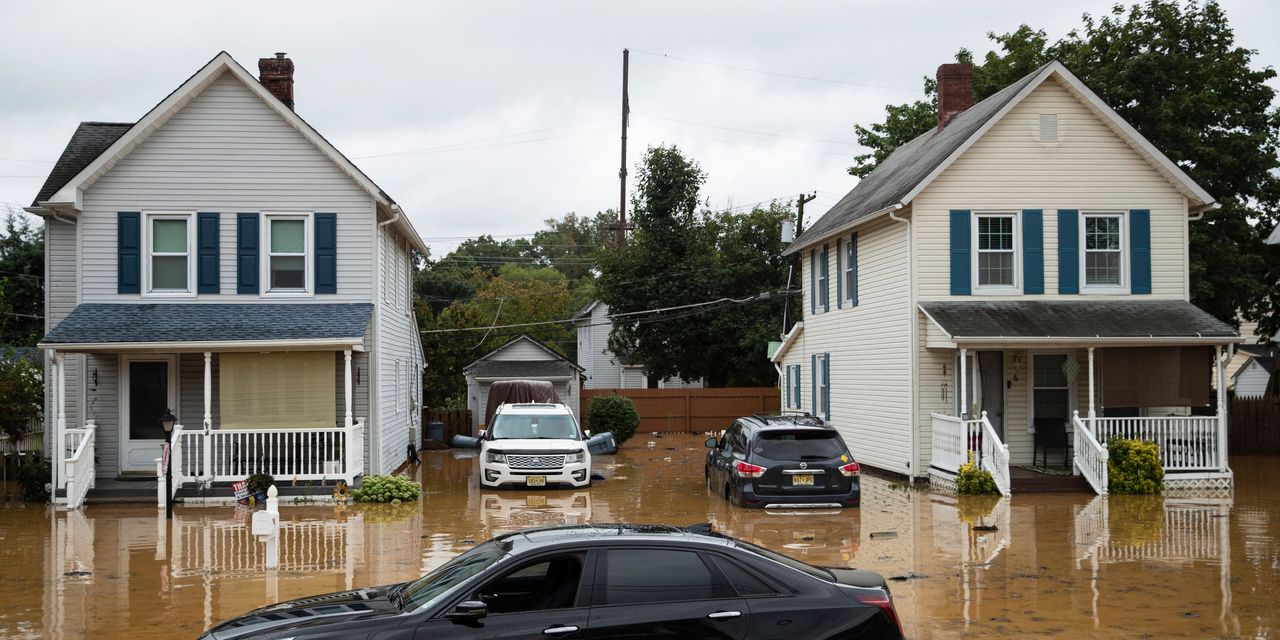
Flooding has long been a worry near rivers and coasts, but costly inundations are happening in areas far from traditional flood zones as climate changes and development impact how water moves through communities.
Recent events suggest the flooding will become a bigger issue in years to come. In 2022, a one-in-1,000-year rain event flooded both St. Louis and Kentucky, while in 2021 Pennsylvania and New Jersey saw flash floods from Hurricane Ida’s remnants.
John Dickson, CEO and president of insurer Aon Edge, which provides private flood insurance, says storm behavior is changing, and more homeowners face flood risk. “Historically, flooding was primarily driven by rising rivers or rising tides on the coast. But more and more, today’s flooding is a byproduct of just incredible, in many instances, record-setting rainfall,” he says.
Major flooding events capture headlines, but even small amounts of water seepage is expensive. One inch of water can cause $25,000 of damage to a home, the Federal Emergency Management Agency says.
There are smart moves home buyers can take to avoid water damage, and it’s easier than ever to use publicly available information to gauge your risk.
Look at the flood maps. Start your research by looking at FEMA’s recently updated flood maps. The new maps account for more types of flooding, including river overflow, coastal erosion, storm surge and heavy rainfall. The new maps include areas previously not in flood zones.
Pay close attention to FEMA’s highest-risk regions, designated with the letter A or V. Those are in “special hazard zones” and have a 1% annual risk of flooding, or a 25% chance of being flooded over a 30-year period.
Standard homeowners’ policies don’t cover flooding, and homeowners with federally backed mortgages are required to purchase flood insurance if they live in a flood zone. Information about the National Flood Insurance Program is at FloodSmart.gov, along with other flood information, including maps. National Flood Insurance Program policies only cover up to $250,000 for the home’s structure and $100,000 for personal belongings, which may necessitate additional private insurance for full coverage. Policies for the flood insurance program range as low as $489 in Maryland to $1,373 in Vermont, according to QuoteWizard.
Flood hazards can change and community development can exacerbate run off. FEMA says more than 25% of its National Flood Insurance Program claims now come from places outside the mapped areas most at risk for annual flooding. Dickson says many people don’t realize their risks, noting less than 5% of the people impacted by the 2022 Kentucky flood were required to buy flood insurance.
Check out the community. If your heart is set on living in a flood-prone area, seek higher elevation. Richard Baker and Mariana Titus can attest to that. Titus’ family home in Franklin, LA., is on Bayou Teche. The town is 10 feet above sea level and 20 miles from the Gulf of Mexico. The house which is built about 13 feet above sea level and has never flooded despite the area being hit by many hurricanes over the decades.
“Old Timers tended to build their towns on the highest ground,” Baker says, adding that new construction west of their area is in low-lying farmlands and have seen devastating floods.
Municipalities may explain their flood resiliency and mitigation efforts on their websites, especially if the town is at high flooding-risk, such as coastal Savannah, Georgia, or Des Plaines, Illinois, located in the plain of the eponymous river. Or just pick up the phone and call the public works department to learn the city’s flood-mitigation practices, says Duane McAllister, senior municipal bond portfolio manager at Baird Advisors.
Ask about retention ponds and other infrastructure, such as if the community has separated the storm water drainage from the sewer system, which helps prevent sewer backups during heavy downpours.
Drive around town and look at land practices, Dickson suggests. “Do you have a community that still has natural resources that can absorb and divert water? Or is it paved over so that when water comes there’s nowhere to go,” he says.
Dickson pointed to a project such as Houston’s Exploration Green, a green infrastructure project in a former golf course that serves as detention ponds for storm water runoff, plus a wildlife habitat and public park.
Know the property’s risk. A real estate agent with deep local knowledge can be a trusted guide, as can robust websites. Mary O’Malley, an-18-year real estate agent at @properties in the Chicago area, says websites such as Realtor.com now include environmental factors such as flood risk in home listings information.
O’Malley works with insurers to find any flooding claims against the individual property as she digs into the property’s risks. She also uses equipment such as cameras to peer into sewers for potential blockages that might cause flooding.
Flood issues can be neighborhood concern or simply a property problem, O’Malley says. If it’s a property problem, some issues can be fixed, such as sealing foundation cracks.
If the neighborhood has issues, homeowner-mitigation steps include installing sump pumps and backup generators to continue running those systems in case of a power failure. Some communities allow homeowners to install check valves that shut the home’s sewer pipe opening to prevent storm water from backing up into the basement. Flood-resistant building materials are another option, such as non-gypsum drywall; FEMA has a list of these types of materials.
O’Malley agrees with Dickson that no place is perfectly safe from flooding.
“The reality is almost everyone lives in an area that has some flooding risk. It’s just a question of high or low,” she says.
Read the full article here