




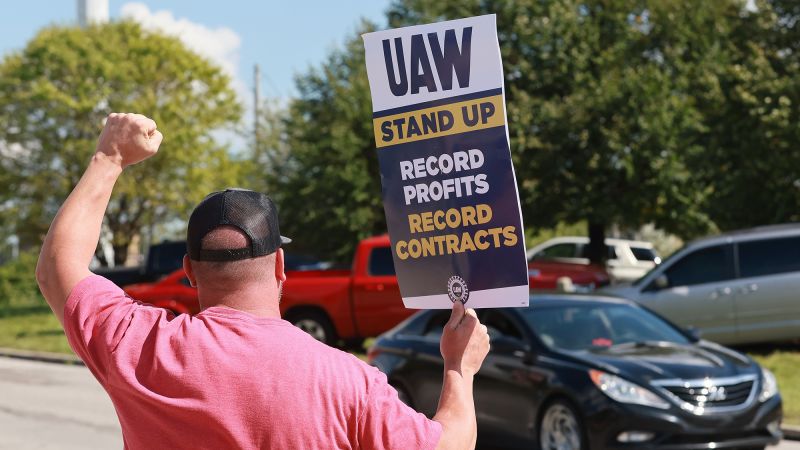
The new labor contracts between the United Auto Workers union and General Motors, Ford and Stellantis will make a big difference in the paychecks of 145,000 autoworkers. It will raise their pay at least 11% immediately, and likely more than 30% over the life of the contract. But it’s not going to make much difference in the prices you have to pay when buying your next car.
“The labor contracts don’t mean you go to a dealership and the car costs more money,” said Ivan Drury, analyst for sales tracker Edmunds. “If wages go up 11%, an overnight change in prices is not realistic. The end result is that for the consumers, the labor cost doesn’t mean a lot.”
Part of the reason is that labor makes up only about 7% of the overall cost of building a car. Raw materials, like the steel and aluminum in the bodywork, the rubber in the tires and the dozens of computer chips that control so many aspects of a modern auto, have a much greater impact.
But the fact is that the three unionized automakers still have to compete in the market with nonunion automakers. Ford, GM, and Stellantis account for less than half of US vehicle sales.
And even though some of those nonunion automakers, such as Toyota, Honda and Hyundai have announced their own pay increases in the wake of the UAW deal, perhaps due to concerns about the threat of the UAW organizing their own employees, though there are still plenty of automakers who are not raising wages.
If the Big Three could simply pass along higher costs, be it raw material, labor other expenses, in the form of higher prices, no automaker would ever lose money. That’s clearly not reality.
“The automakers will have difficulty passing those costs onto consumers,” said Michelle Krebs, analyst with Cox Automotive.
Even if the labor costs could be passed along in terms of higher prices, it woudn’t be nearly as much as you might think. The labor deal is likely to raise the cost of building vehicles by $950 per car, according to Ford CFO John Lawler. But that $950 is the total increased cost from the labor contracts that will be paid over the course of four-and-a-half years of the contract. Or about $200 more per year, with less of that increased expense coming in the near term and more at the end of the contract.
Any additional labor costs are more likely to eat into automaker profits than they are to raise prices. Ford reported that it earned about $3,000 before interest and taxes for every gas or hybrid vehicle sold to consumers in the first 9 months of the year. So a few hundred dollars a year in higher labor costs aren’t going to break the companies, or send them back to the massive losses that they experienced in the first decade of this century.
Car prices are driven far more by supply and demand than by the cost of the vehicle. The average transaction price reached $48,760 in October, according to Edmunds’ data. That’s less than $50 below the record average car price set in December of 2022, and it’s up about $10,600, or 28%, from the average price in October 2017.
That substantial price increase was not driven by an increase in costs, labor or otherwise. It was driven mostly by strong demand for autos, and a limited supply of vehicles due to the shortage of some parts, most notably computer chips.
That led to a period in which most buyers were being forced to pay above the manufacturers’ suggested retail price, or “sticker price.” In past years, very few car buyers ever had to pay above sticker price for a car.
Most American new car buyers aren’t actually buying directly from automakers, but from dealerships, which are independent businesses that buy cars in bulk from automakers at wholesale prices, and sell them at whatever price the market will bear.
Another factor driving car prices higher was the desire of consumers to buy cars with more features and options that are now available but were not available in the past. And the demand for those extra features are among the factors raising the average price of a car, even if the price of the most basic, stripped down models have not increased as rapidly.
Read the full article here