




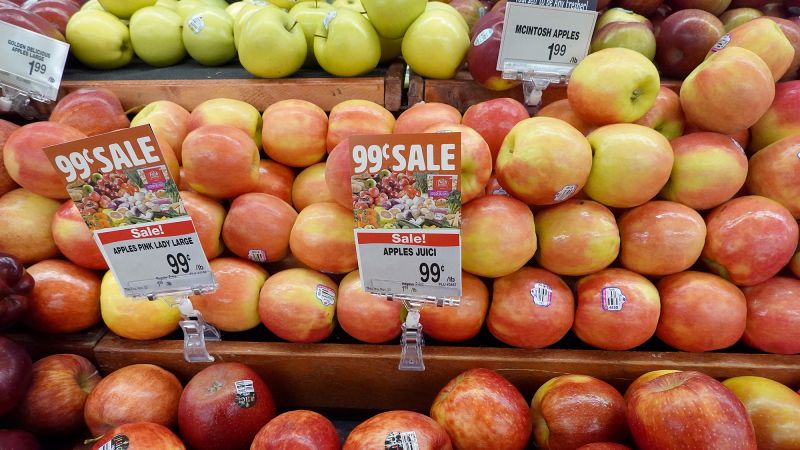
As you make your way down the grocery aisle, maybe picking up supplies for apple pie, you might notice something interesting. The price of flour, sugar and butter? Up. But the price of apples? Way down.
From September to October, adjusting for seasonal swings, flour prices rose 0.9%, butter got 2.1% pricier and sugar prices were up 1.6%, according to the latest Consumer Price Index data from the Bureau of Labor Statistics.
But apple prices plunged 7.9%.
Consumer packaged goods companies have been raising prices, affecting what shoppers see in center aisles. But in the dairy aisle and the produce sections, prices are more closely tied to what’s happening in the natural world. Bad weather, exacerbated by climate change, can mean a bad crop, squeezing supply and driving up prices. Good weather can have the opposite effect.
This year, apples are plentiful (and delicious) thanks to great apple-growing weather — moderate temperatures with nice moist soil — in the spring. That, coupled with typical seasonal trends, lower freight costs and changing dynamics in the export market, has pulled down prices this fall.
That’s good for apple enthusiasts and pie bakers. But it’s got farmers, already facing a challenging environment because of high costs and unpredictable weather, on edge.
In general, apple prices dip in the fall, because that’s when they’re harvested and flood the market. But a supply glut this year has made the price decline even sharper.
This past spring, apple growing conditions in the United States were ideal — a welcome reversal following a few rough seasons.
Two years ago, extreme heat “baked apples on the trees,” said Chris Gerlach, director of industry analytics at the US Apple Association, which represents the apple industry in the US. And last year, a cold spring made pollinating bees kind of lazy. “There were tired and cold bees that weren’t going from flower to flower the way they wanted them to,” Gerlach said. That, too, meant a smaller crop.
This year, finally, the environment was just right. “We’ve seen pretty ideal conditions,” in the US this year, said India Colegrave, scientific technician of specialty agricultural data at Gro Intelligence. “We have warmer spring temperatures and great soil moisture levels.”
The result? A bounty of fruit.
Washington state, the country’s top apple producer, is expecting to produce 140 million 40-pound boxes of apples for retail this year, according to Jon DeVaney, president of the Washington State Tree Fruit Association. That’s up sharply from 104 million boxes last year and is also much higher than the roughly 123 million in 2021.
Over the summer, the US Apple Association predicted that the US overall would have 1.5% more apples this season than last.
Competition increases abroad and at home
Cheap gas has made it more affordable for apple growers to ship across state lines, increasing competition between different parts of the country, said Gerlach.
And in general, more apples are staying in the domestic market. In 2019, amid a global trade war, India imposed retaliatory tariffs on a number of products coming from the US, including apples. The tariffs slashed apple exports dramatically. India lifted those extra measures earlier this year, and ultimately the USDA predicts that apple exports to the country “have the potential to climb from $4.8 million in 2022 to $50-$80 million in 2024.”
But it might not be so easy to bounce back, said Lynsee Gibbons, director of communications for the US Apple Association.
“In the years that we’ve had an absence there, they have filled that demand with apples from Turkey and Iran and some other markets,” she said. “Now, the US has… to reacquaint ourselves with that market and get our way back in there.”
The war in Ukraine has also shifted international apple market behavior, said the Washington State Tree Fruit Association’s DeVaney.
“A lot of European apples … had previously gone into Russia and Ukraine,” he said. “They are diverting their crop to other markets in the Middle East and South Asia that were previously prime markets for US and Washington apple exports.”
For farmers, the good crop this year is in many ways a relief. But the lower prices pose yet another challenge to their business.
“This year, we’re all quite concerned,” said Craig Campbell, a third-generation fruit farmer who owns Harmony Orchards in Washington.
“These apples today are being sold close to the cost of production here, in some cases, less than cost of production,” he said. “We have a lot of volume, but I don’t know if we’re gonna be making any money this year.”
Though gas prices have fallen, apple farmers have other rising costs, including labor.
“We’re under a lot of pressure,” said Campbell. “Our input costs are not keeping up with prices this year.”
In general, pricing has not been trending in a way favorable to farmers, said DeVaney.
Despite recent swings, “we’ve seen fairly stable apple pricing over many years,” he noted. “I’ve talked to growers who go back in their sales records and say, well, 10 years ago, I was getting the same price for my fruit that I am now, in dollars — so no adjustment for inflation.”
From 2008 to now, prices paid to farmers for Red Delicious apples n the Yakima Valley and Wenatchee in Washington have swung up and down but on average remained pretty steady, according to figures from Gro Intelligence. “Current [price] levels are more like the middle of the historical range,” said Jonathan Haines, senior research analyst at Gro Intelligence.
To cope with rising costs and improve sustainability, many farmers have been making adjustments to how they operate, said Todd Fryhover, president of the Washington Apple Commission, which promotes the state’s apple industry.
Some have swapped old varieties for new ones, which can be sold at a premium, packing in more trees per acre when they do so. “We’re trying to utilize our grounds better,” he said. “Our resources are limited, labor is limited, so we’re trying to make our orchards more efficient to reflect those challenges.”
The efforts have increased apple output over time, he said.
But replanting trees and putting in new infrastructure requires investments that some small farmers just can’t afford.
The dynamics have led to more consolidation in the industry, said Fryhover.
“We’re seeing the smaller growers not being able to be competitive,” he said. “They’re either having to get bigger or they’re having to get out.”
Read the full article here