




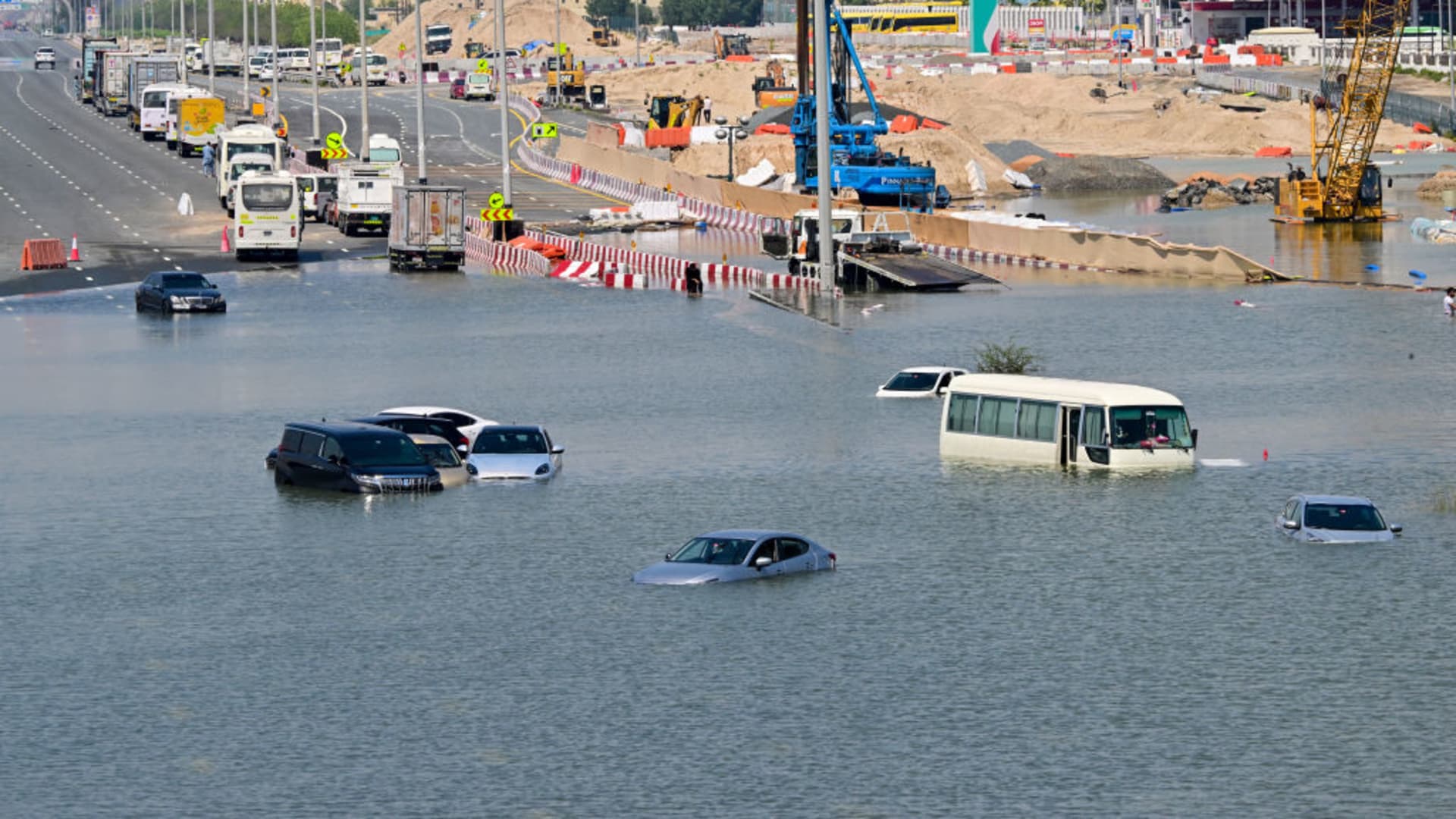
The Dubai flooding last week illustrated how urban engineering is failing a major climate change test. In a world marked by the increasing possibility of extreme weather events, no matter how big and modern expanding urban environments around the globe get, they don’t have enough places for all the water to go when there’s too much of it.
The United Arab Emirates’ city and others like it built on previously uninhabitable areas reflect 20th century urban development ideas that result in the blocking of natural water absorption systems. Add increased populations, bringing with them more waste — and more need for landfills and other waste disposal methods — and the drainage challenge will continue to bedevil major global cities like Dubai facing more frequent, massive rainfalls.
Last Tuesday, the UAE received more than 10 inches of rainfall in some places, and roughly half of that level in Dubai, amounts equal to annual rainfall averages in the UAE. More frequent rainfall in recent years in the UAE is expected to get even worse in the years ahead. Claims were made last week that experiments the UAE has been conducting with cloud seeding contributed to the rainfall, but the government told CNBC that was inaccurate, and other experts have dismissed those claims.
What’s known is that Dubai was built on sand, a natural environment which lets water seep into the soil very easily. But by pouring massive amounts of concrete on top of Dubai’s natural terrain, the developers effectively blocked the soil from absorbing water. Last week’s rainfall was the largest amount of precipitation recorded since the country began keeping tabs in 1949.
“We have natural drain places that bring water directly to the aquifers and then inside our water stocks,” said architect Ana Arsky, CEO of environmental startup 4 Habitos Para Mudar o Mundo. “When we pave, it’s not there anymore,” Arsky said.
The rapid rise of populations tied to global urbanization trends adds to waste, and while trash isn’t visible on Dubai’s streets, it has to go somewhere, often ending up in less than ideal locations. Plastic products don’t absorb water well, and when they end up in landfills around the world, massive piles of trash contribute to a global backup of natural drainage systems.
Even older cities with established drainage systems are facing similar issues, as residents of New York City discovered last fall, with flooded schools, roads and homes, and subway and railroad service halted after a single day’s rainfall reached between 5 and 8 inches in some places. Without proper preparations, manmade drains full of debris and pollution can’t absorb the increased water, leading to backups and flooding.
“Rainwater drainage systems, they are not adapted for the flows that we are seeing currently with climate change and with extremely concentrated rainfall,” said Tiago Marques, co-founder and CEO of Greenmetrics.AI. “You get a saturation of the drainage system that doesn’t have any way of draining the amounts water that have been falling recently. This ends up coming to the surface and causing urban flooding, whether you’re talking about tunnels, highways or the lowest parts of the city.”
Greenmetrics.AI installs sensors and uses data analytics to predict rainfall impact and help advise communities on water consumption, and is currently working with civil authorities in six cities in Portugal.
Marques said that citizens tends to blame municipal officials when flooding occurs for not properly cleaning drainage systems, but in Porto, Portugal, there was serious flooding in several parts of the city last year and the drainage systems had been cleaned. “The amount of water was so high and so unusual that it basically swept all the branches and even trash into the drainage systems that were previously clean, and blocked them,” Marques said. “When all this water starts to pile up, it’s very hard for the authorities to know exactly what’s happening everywhere at the same time.”
Greenmetrics places smart sensors with LIDAR – the same technology that is used to direct self-driving cars – in areas that are vulnerable to flooding to warn if levels are getting too high to manage. Coupled with better understanding weather patterns, authorities can clear drains and debris before flooding hits. In cases where flooding is inevitable, the technology can give people time to evacuate or for leaders to shut down locations to minimize casualties.
“What you used to have every 100 years … starts to happen every 10 years,” Marques said. “Then the floods that have been happening once every 10 years now are starting to happen every couple of years. Climate change adaptation means building resilience technologies.”
Vapar, a startup that builds sewer drain and pipe-inspecting robots to find issues before major storms hit, has partnered with governments in Australia and the U.K.
Arsky’s 4 Habitos Para Mudar o Mundo, helps companies, including AB-InBev and bank Banco Itaú in Brazil, as well as consumers categorize waste with the help of artificial intelligence so it can be disposed in appropriate areas to minimize impact on drainage. It is also working on developing building materials strong enough for structures, but porous enough to allow water to still be absorbed by the area’s natural soils.
More frequent flooding in more of the world’s most-densely populated environments is another reminder, Arsky says, of the underlying message being sent to the world in events like the Dubai flooding: “Climate change has no specific address.”
Read the full article here