




Editor’s Note: A version of this story appeared in CNN Business’ Nightcap newsletter. To get it in your inbox, sign up for free, here.
University presidents have to wear a lot of hats, much like a CEO.
There’s the day to day admin, the glad-handing of donors, and, crucially, keeping internal fires from becoming public, violent conflagrations.
That last one is a public relations lesson, one on which Columbia’s president might need a refresher.
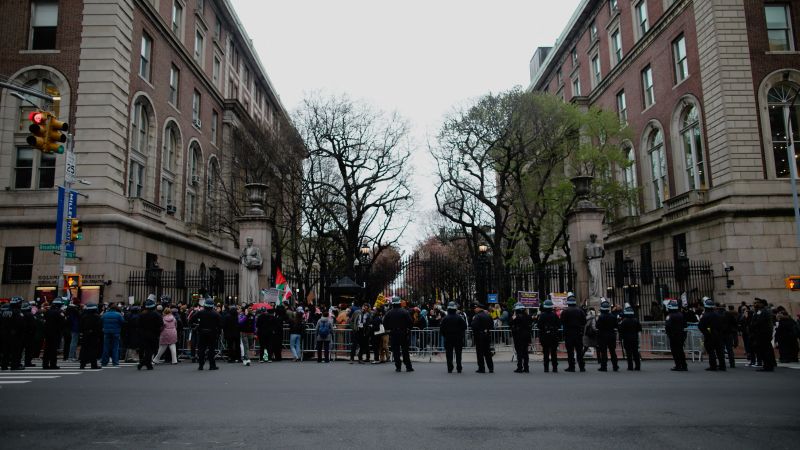
See here: To understand why so many college campuses suddenly have students occupying parts of their campuses, you have to go back to two weeks ago, on April 18, when Columbia University called in the NYPD to bust up an encampment that pro-Palestinian protesters had set up just a day earlier.
In doing so, Columbia’s leadership threw out the playbook for managing protests that universities have honed for decades to keep students safe.
“There is a particular set of tactics that many of us in academia thought was an understood logic that university administrators have used to manage and control protesters,” Sarah J. Jackson, a professor who studies the role of media and technology in movements for justice at the University of Pennsylvania, told me.
Chief among those tactics: Delaying and distracting.
The administration might tell activists, in good faith, “OK, we hear you and we are going to set up a committee to investigate what it would take to accomplish some of your demands.” Officials might ask the student protest leaders to put together a case to present before the Board of Trustees.
“The protesters don’t necessarily appreciate these tactics, because they’re strategies of control,” Jackson says. “But from my perspective, they’re also strategies that largely have prevented the large-scale violence against protesters on college campuses that we saw in the 1960s.”
Academics are accustomed to seeing those tactics deployed, especially when students are days away from the end of the semester — a natural time for agitators to lose steam and head home. But that didn’t happen at Columbia. “That’s part of why it’s been so shocking to see the level of physical suppression that has happened instead,” Jackson said.
The shockingly aggressive intervention by police is also why, overnight, dozens of campuses across the country saw students stage their own encampments in solidarity.
When non-violent protesters are met with intense physical suppression, “that tends to create a kind of outrage effect that then generates more protests,” Jackson said.
“I think everybody can understand in this moment that the reason all these encampments suddenly popped up all over the country is because of what happened at Columbia feeling so egregious, and so sudden, and so unreasonable.”
Along the way, it’s become increasingly clear that university comms teams are not helping. Jackson echoed what Nadia Abu El-Haj, an anthropology professor at Columbia, told the New York Review this week, that administrators appear to be “making up rules as they go along, often without even announcing the changes.”
“We, as faculty members, find out that the rules have changed when the students get hauled into a procedure that didn’t exist before,” Abu El-Haj told the publication.
To be sure, Columbia’s president, Minouche Shafik, knows her job could be on the line. Late last year, the presidents of Harvard and UPenn stepped down after their overly lawyered responses about antisemitism on campus stoked outrage. Meanwhile, thousands of students, parents and alumni are about to descend on Columbia’s campus for commencement, adding more pressure to remove protesters.
Of course, other campuses have commencement plans, and several have managed to deal with potential disruptions without calling the cops.
Protesters at Brown University, notably, disbanded their encampment voluntarily, and peacefully, after the school engaged with the activists and agreed to consider some of their demands. Other schools like Wesleyan and the University of Chicago avoided police intervention with similar tactics.
Those campuses are the ones that are staying out of the news, Jackson notes. From a PR standpoint, that “certainly seems like it would be a preferable outcome.”
Read the full article here