




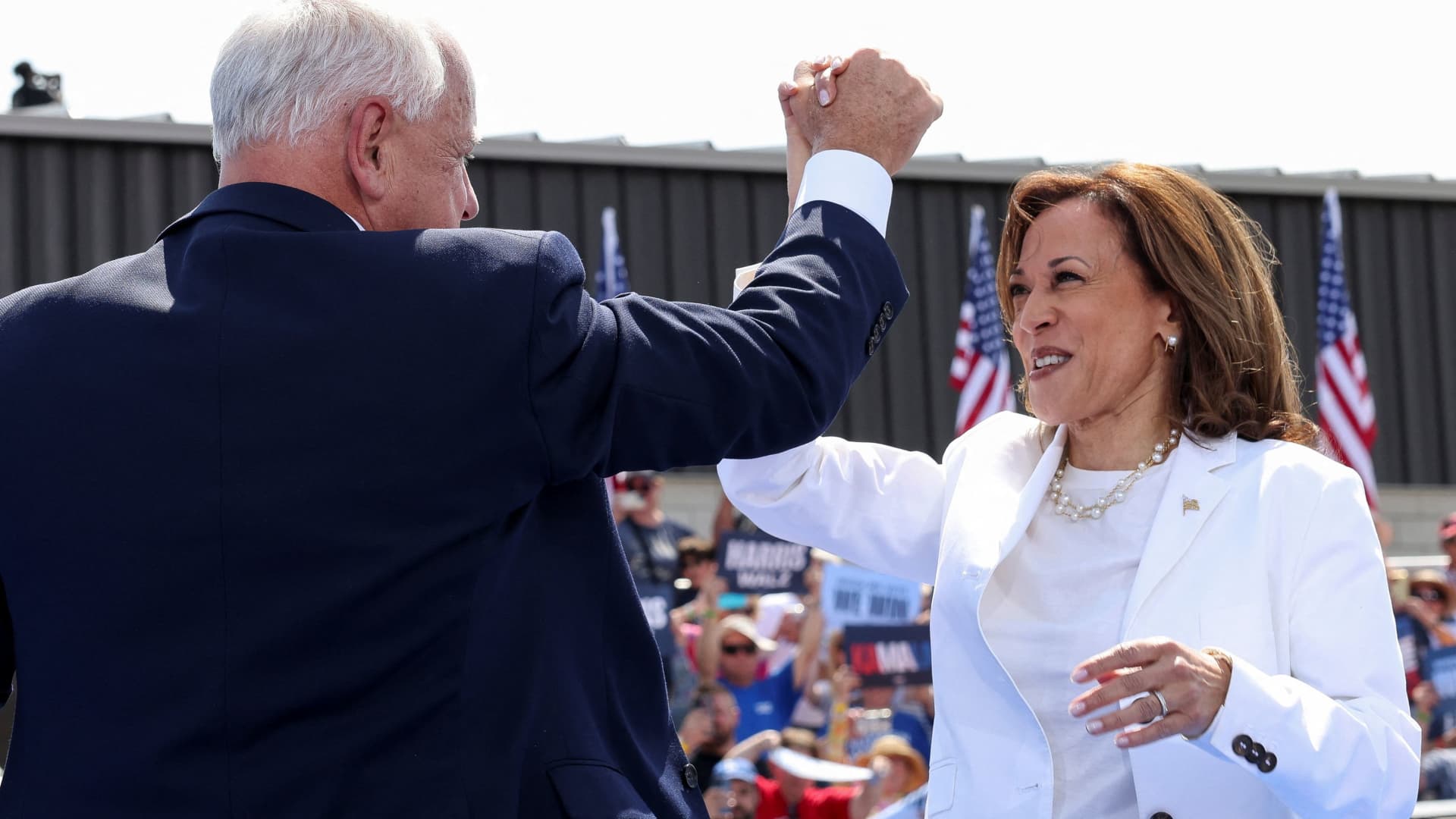
When Kamala Harris chose Minnesota Governor Tim Walz, a former teacher, as her running mate, experts noted he could bring a revitalized policy focus on child care and early childhood. As governor, Walz expanded state child tax credits and built a paid family leave program. Walz also distributed funds to boost early child-care professional wages and build provider capacity. Harris is “doubling down” on child care, said one expert.
In the national economic platform unveiled by the Harris administration on Friday, restoring the expanded federal child tax credits introduced during the Covid pandemic is a key priority, and is linked to the financial stress that many families with young children to care for are facing.
Describing the current economy as one in which “many family’s expenses are highest — with cribs, diapers, car seats and more,” Harris proposed expanded tax relief of up to $6,000 for families with a newborn. Donald Trump’s running mate J.D. Vance also proposed nearly doubling the current child tax credit to $5,000 on CBS last Sunday.
One of the biggest expenses of all is child-care support, and that is not only a concern for government policymakers and candidates for office. As companies look to sustain recent growth and stay ahead of long-term tightness in the labor market, child-care policy is a concern for America’s employers. Child care is less accessible than ever for families across the economic spectrum, with costs 32% higher today than in 2019, according to Bank of America research. Child-care centers see high costs for providing care — costs piled upon families. Many parents consider leaving the workforce given the economics, and parents already miss days of work when left without child care center access.
According to a recent Boston Consulting Group study, only 12% of workers, and only 6% of part-time and lower-income workers, have workplace access to child-care benefits. The study found that for every dollar employers spend on child care, the company gets $4.25 in return on investment. Research conducted in 2019 by the nonprofit arm of the largest business lobby, the U.S. Chamber of Commerce, stressed the importance of employer support for more child-care access.
Jessica Chang, founder of child-care startup Upwards, which works with employers including Amazon and the U.S. Army to provide benefits, told CNBC that child care can no longer be viewed solely as a social issue — it must be viewed as an economic one.
Child-care supply and demand challenges
A forthcoming study from Upwards cites a paradox in the child-care sector: both shortages and underutilization. U.S. Bureau of Labor Statistics data shows that 51% of Americans live in areas with three children for every available child-care spot, but only 11% of providers were at full capacity at any given time in 2023. Massive pandemic emergency investments have run out and left the child-care industry vulnerable, with low wages and a shrinking workforce.
Directly embedding child-care benefits in the workplace can help connect workers to the services they need, and help child-care providers boost their capacity to serve more children and families.
“We only think, ‘Oh, this is really costly, but what is the cost if you don’t do it?” Chang said. “We already know that the cost of replacing an employee can sometimes be as high as four times their annual salary.”
Across Upwards case studies, retention rates are five times higher for employees utilizing its child-care benefits than the average employee in the same workplace, which she said reinforces the argument that employers must focus on the costs, and lost benefits, of not providing child care.
Over $100 billion lost annually
An estimated $122 billion is lost annually by the U.S. economy in earnings, revenue, and productivity as a result of the early childhood care crisis. The cost to families, businesses, and taxpayers almost doubled from 2018 to 2023. Companies also lose billions related to recruitment and talent retention, according to a 2023 study from national childcare advocacy nonprofit ReadyNation.
According to ReadyNation, nearly 85% of primary caregiver parents said challenges in obtaining child care hampered their work efforts, and over one-quarter have been reprimanded while facing these challenges. Over one-half of all parents of young children facing child-care challenges discussed leaving early or late, and missing days of work.
“We all benefit when people that want to work have the ability to work,” said Nancy Fishman, a ReadyNation senior advisor.
There is a disproportionate effect of child-care challenges on mothers, often called the “motherhood penalty,” leading them to exit the workforce in high numbers and remain out for years after having a child.
According to the latest “State of Motherhood Report,” 66% of women in the U.S. consider leaving the workplace due to lack of child care, an all-time high in the annual study. As costs of child care rise, this proportion may increase.
Upwards’ study finds a multiplier effect of economic gains from allowing more women to remain in the workforce by supporting and subsidizing child care. It combines a woman’s average yearly salary, the absenteeism and production savings of employers, and the average turnover cost savings of employers, showing the massive impact child care, and working mothers, have on the economy.
Government policy obstacles
The Harris goal of an expanded child tax credit won’t be easy. And it seems that getting all employers on board with providing child-care benefits will provide another challenge. The Biden administration’s CHIPS Act, which subsidizes corporations to set up semiconductor facilities in the U.S., required applicants for funding of over $150 million to provide access to child-care benefits, a previously untested policy concept in the U.S., though common overseas. Commerce Secretary Gina Raimondo called the politicization of these benefits in the U.S. “deeply misguided” and a net negative for the economy.
The Biden administration has failed multiple times to pass an expanded child tax credit coupled with business tax breaks, even with initial bipartisan support for the legislation. As all eyes are on both potential presidential administrations’ policies for working families, private and public actors have yet to resolve tax and subsidy debates that plagued earlier efforts. Inaction and gridlock may continue, even as the research shows that financial conditions for working parents with young children are not improving.
Read the full article here