




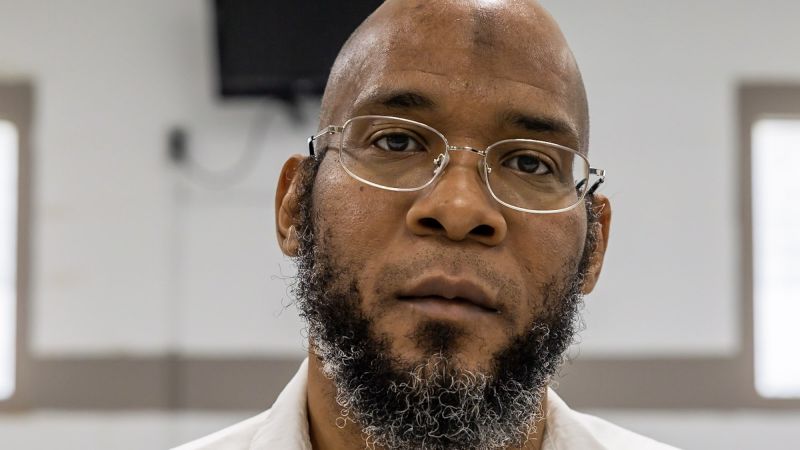
The Supreme Court’s divided decision this week allowing Missouri to execute a man for a 1998 murder even though his conviction was contested by prosecutors has heaped renewed scrutiny on the court’s approach to the death penalty.
Marcellus Williams, convicted in 2001 of killing former newspaper reporter Felicia Gayle, was executed Tuesday evening, a little more than an hour after the Supreme Court’s conservatives declined to intervene over the objection of the three liberal justices. The execution drew sharp criticism from the NAACP and other groups who claimed Williams was innocent.
Some of that blowback has been directed at the Supreme Court, which for decades has only rarely granted last-minute reprieves for death row inmates. The court has stepped in twice in the past two years to stop executions out of more than two dozen emergency appeals, according to data compiled by the Death Penalty Information Center.
“It’s very troubling the way that the Supreme Court is approaching capital cases these days,” said Cliff Sloan, a professor at Georgetown Law who won a significant case at the Supreme Court in 2017 involving an intellectually disabled death row inmate. “In any fair and just society, a freestanding claim of innocence should be recognized as an important constitutional claim.”
When dissents are noted in capital case petitions, they invariably come from the court’s liberal wing. And when the appeals make their way onto the court’s docket for further review, the outcome tends to divide the liberals and conservatives into separate camps.
“The Supreme Court has a limited role to play death penalty cases,” said Paul Cassell, a University of Utah law professor who is representing a victim’s family in another death penalty case before the high court this year. Those cases, Cassell said, are “handled primarily by state authorities with limited oversight from the federal courts.”
The death penalty will continue to feature prominently at the Supreme Court in coming weeks, with several defendants up for review when the justices meet Monday to consider appeals that piled up over the summer. One involves an Oklahoma woman convicted of killing her husband who says prosecutors sex-shamed her during her trial, referring to her in court as a “slut puppy” and holding up her underwear for the jury.
Another involves an Alabama man who claims he is intellectually disabled and therefore ineligible for execution under Supreme Court precedent.
The court is already set to hear arguments about Richard Glossip, a death row inmate in Oklahoma. The case involves the 1997 killing of Barry Van Treese, the owner of a motel in Oklahoma City. Justin Sneed, who worked at the motel, was convicted of that murder but, in exchange for avoiding a death sentence, implicated Glossip as orchestrating and hiring Sneed to carry out the crime.
Glossip is asking the court to set aside his conviction after the state acknowledged its case was rife with errors. Prosecutors, for instance, failed to disclose records showing that Sneed, who was the key witness against Glossip, was treated for a psychiatric condition. Oklahoma’s attorney general, Republican Gentner Drummond, who has defended the death penalty, is siding with Glossip, citing “troubling evidence of grave prosecutorial misconduct.”
Williams, whose execution promoted outrage on social media, tried to liken his situation to Glossip’s, noting that prosecutors had similarly raised serious concerns about his trial. Among other problems, St. Louis County Prosecuting Attorney Wesley Bell said that his predecessor had contaminated the murder weapon by handling it without gloves. Bell, a Democrat, is running for Congress.
In Williams’ case – unlike in Glossip’s – the state was still firmly in favor of an execution. Missouri Attorney General Andrew Bailey, a Republican running for reelection, dismissed Williams’ theory that DNA testing of the knife might have exonerated him had it been handled more carefully by prosecutors. Instead, Bailey said, “the evidence was consistent with the testimony of a crime scene investigator that the killer wore gloves based on glove marks left at the crime scene.”
The two cases have enough overlap that some believe the outcome for Williams could signal problems for Glossip.
Missouri executes man despite legal questions
“When you have a catastrophic failure by the state courts to address these issues, you’d expect the US Supreme Court to step in, especially when you have an (appeal) that is filed jointly by the trial prosecutor’s office and the defense,” said Robert Dunham, director of the Death Penalty Policy Project, who has also represented death row inmates at the Supreme Court. “It becomes very difficult to come up with a justification for what happened.”
Cassell, who is representing the Van Treese family in the Gossip appeal, said that those supporting the defendant’s claims have made themselves “willfully blind to the facts of the case here” and are basing their concerns on a “few snippets in the prosecutors’ notes.”
The Supreme Court didn’t explain its reasoning in denying Williams’ request. The court’s three liberals – Justices Sonia Sotomayor, Elena Kagan and Ketanji Brown Jackson – noted their dissent but also did not write to explain their position.
Sotomayor, in particular, has made her opposition known in some past death penalty appeals.
In January, when the Supreme Court allowed Alabama to execute Kenneth Smith with nitrogen gas, Sotomayor wrote a strongly worded dissent.
“Having failed to kill Smith on its first attempt, Alabama has selected him as its ‘guinea pig’ to test a method of execution never attempted before,” she wrote. “Once the nitrogen is flowing into the mask, his executioners will not intervene and will not remove the mask, even if Smith vomits into it and chokes on his own vomit.”
Smith was executed in late January.
In a landmark 1972 decision, the Supreme Court ruled that the way states were carrying out the death penalty represented cruel and unusual punishment in violation of the Eighth and 14th Amendments. While the decision vacated hundreds of death sentences, it did not ban the practice completely. Instead, a majority of states enacted new laws that restored executions in a way that was consistent with the court’s ruling.
The court’s general reluctance to review last-minute death penalty appeals is based in large part on its role within the federal judiciary. The justices are looking for clear errors made by lower courts, not new evidence raised by defendants.
The Supreme Court’s approach to death penalty appeals is “to correct severe misapplications of constitutional law by America’s state court systems,” said Seth Kretzer, a Texas attorney who has represented death row inmates at the Supreme Court.
The court, Kretzer said, “will not stop an execution in a discrete case just because that inmate adduces new evidence at the last minute.”
The high court will make clear in coming weeks whether the current pending cases will meet that high bar or not.
In one pending appeal, lawyers for Alabama death row inmate Joseph Smith is fighting his sentence on the grounds that he should be considered intellectually disabled. A series of tests put Smith’s IQ at just over 70, a threshold referenced in an earlier Supreme Court decision.
But the 11th US Circuit Court of Appeals said that the number isn’t a strict cutoff and that deviation in testing could put his actual IQ slightly below 70. Alabama is appealing that decision to the Supreme Court and has been waiting more than year for an answer.
In Oklahoma, Brenda Andrew faces the death penalty for the 2001 shooting death of her estranged husband. In her appeal to the Supreme Court, Andrew said the prosecution’s use of “plainly irrelevant sexual history,” should knock out her conviction.
“By stripping Ms. Andrew of her humanity as a whole person, the state instead offered the jury an archetype of a ‘slut’ and depraved adulterer,” her lawyers told the Supreme Court.
Oklahoma officials countered that the evidence “indicated that Andrew hated her husband, and she made no secret of her desire to see him dead.”
CNN’s Devan Cole contributed to this report.
Read the full article here