




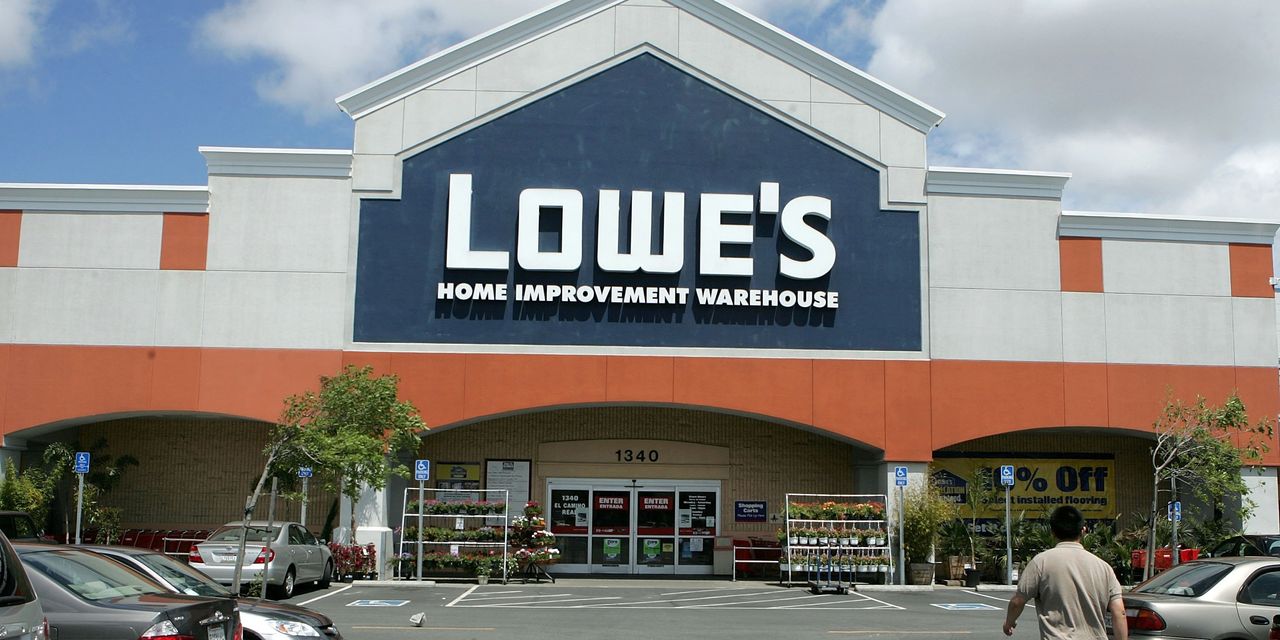
Lowe’s is the latest retailer sounding a downbeat note on outlook, but it’s stock is rebounding after early declines.
The retailer followed rival
Home Depot
(ticker: HD) in cutting its full-year forecast on a downcast view of the home-improvement sector, although that was largely expected ahead of the report.
Lowe’s shares (LOW) were falling in premarket trading, but then reversed course and were up 2.9%, at $209.06, in recent trading.
Lowe’s reported adjusted earnings per share of $3.67, up 5% from the same period the previous year.
Total sales for the quarter were $22.3 billion. Lowe’s said comparable sales fell 4.3% from the previous year, driven by lumber deflation, unfavorable weather, and reduced discretionary home-improvement spending.
Lowe’s had been expected to report adjusted earnings of $3.45 a share on sales of $21.60 billion, according to a FactSet poll of analysts’ estimates.
“Although we delivered positive comparable sales in Pro and online for the first quarter, we are updating our full-year outlook to reflect softer-than-expected consumer demand for discretionary purchases,” said CEO Marvin Ellison.
Lowe’s cut its full-year forecast for adjusted diluted earnings a share to $13.20-$13.60 from $13.60-$14.00 previously.
The company said it now expects total annual sales of approximately $87 billion-$89 billion, down from $88 billion-$90 billion previously. It expects comparable sales to fall from the previous year by a range of 2% to 4%, against a previous forecast of a range of flat sales to a drop of 2%.
The retailer followed Home Depot, which cut both its top- and bottom-line guidance for the full fiscal year last week. The company said it expects sales to fall in a range of 2% to 5% from 2022.
Barron’s noted ahead of the report that Lowe’s investors were likely braced for bad news after hearing Home Depot’s forecast. Although Lowe’s played catch-up with Home Depot throughout the pandemic boom in home-improvement demand, both companies have been hit this year by shifting consumer priorities and a constrained housing market.
While Lowe’s is growing its Pro business, the company has always skewed more toward DIY consumers than Home Depot. That’s a benefit when people try to save on labor costs and do repair themselves, but DIY projects can also be more discretionary, and Lowe’s is just one of many retailers this quarter, from
Target
(TGT) to
Foot Locker
(FL), that has called out weakness in discretionary categories as strapped consumers focus on essentials.
Nonetheless, DIY still outperformed the Pro segment in Home Depot’s quarter, and while demand is down overall, it may have still helped Lowe’s: As D.A. Davidson analyst Michael Baker noted, Lowe’s comparable sales were 30 basis points better than Home Depot’s in the U.S., the first time Lowe’s outpaced its larger rival since the fourth quarter of 2020. (A basis point is 1/100th of a percentage point.)
“While Lowe’s likely benefited from less West Coast exposure, where the weather issues were more pronounced, LOW was able to show increases in the pro business, while Home Depot’s pro business fell,” Baker wrote.
On the company’s conference call, management said it was “optimistic” that customers would “reengage with spring projects” after foul weather dampened sales. It also said second-quarter sales would likely come in near the high end of its guidance, another positive note, while operating margins continue to expand.
Write to Adam Clark at [email protected] and Teresa Rivas at [email protected]
Read the full article here