




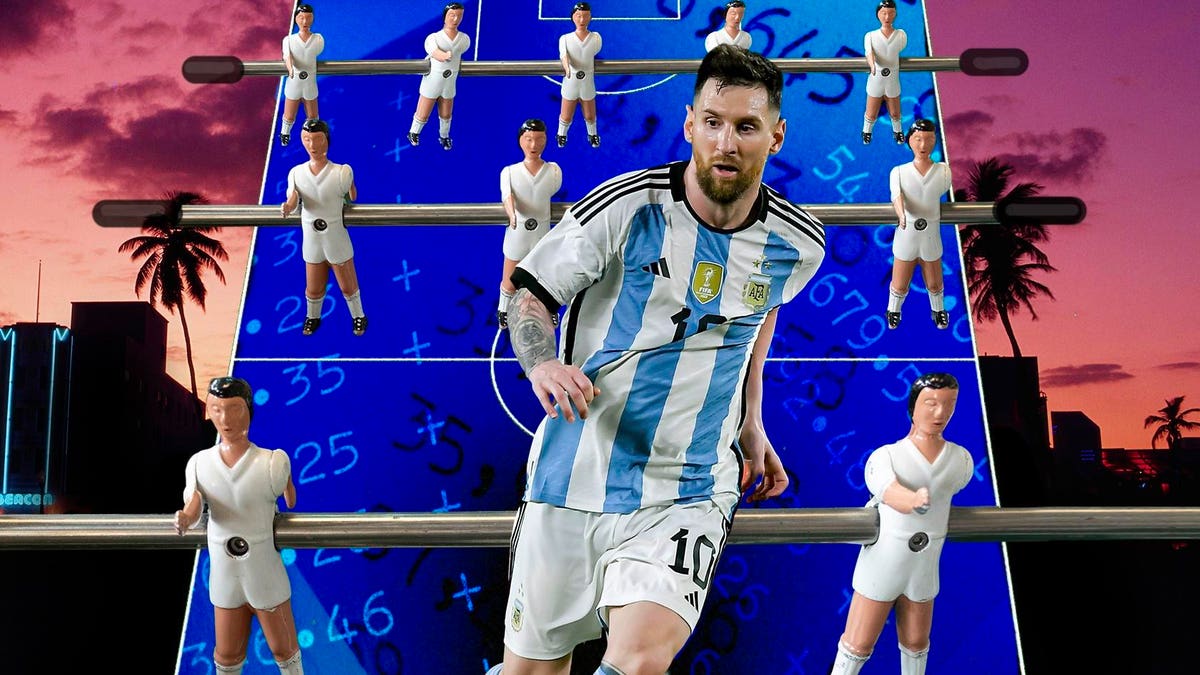
The greatest soccer player in the world made a smart move choosing Florida, a state with no income tax. But his first goal is to clear U.S. immigration with a Spanish tax fraud conviction on his resume.
On June 24, Philadelphia Union will take on Inter Miami at Subaru Park. Normally, a match-up between the 3rd and 15th-place teams in the eastern conference wouldn’t generate much interest. But the game—still seven days away—is already sold out.
Call it the Messi effect. Soccer star Lionel Messi won’t be at the game on June 24 since his contract with Paris Saint-Germain doesn’t even expire until June 30. But the mere announcement that he would sign with Inter Miami, eschewing much bigger deals abroad—including a $500 million offer from Saudi Arabia’s Al-Hilal—already has fans buzzing. Inter Miami, which already saw its stock rise when David Beckham signed on as co-owner, now has over 8 million followers on Instagram, more than any other Major League Soccer team. The Dallas Cowboys, which Forbes ranked as the world’s most valuable sports team in 2022, has only 4.5 million.
The 35-year-old Argentine is considered by many to be the greatest soccer player in the world. He has seven Ballon d’Ors—literally “the golden ball” award, considered the most prestigious in soccer–and multiple other individual awards, including FIFA Player of the Year. Plus, he’s steered teams to 10 La Liga Liga titles, four UEFA Champions League titles, and two Ligue 1 titles. In 2022, he finally captured the elusive World Cup for his home country of Argentina.
With that resume, Messi could have gone anywhere. But another part of his history–namely his earnings and protracted battle with Spanish tax authorities–suggests one reason he might have chosen Florida, a destination for other big, high-earning sports stars like Tiger Woods, Derek Jeter, and Tom Brady.
For the highest earning athletes, Florida is a great place to live and/or train and play. Florida does not have a state individual income tax. That doesn’t guarantee a star athlete who lives there a state income tax free existence, but it does help cut the bill–particularly if that athlete is playing for a Florida based team. States with income taxes typically impose them based on both where you live and where you work. (Since federal law doesn’t allow two states to tax the same income, those who live in one state and work in another, will often be required to file in both states and will then get a credit in their home state for the taxes paid or withheld in the state where they worked.)
This can be particularly tricky–and a big deal–for athletes. While some states have laws that exempt workers from being subject to tax if they’re only in the state for a short time—typically 30 days or less—those rules don’t usually apply to professional athletes, who get hit wherever they play a game. And yes, in case you were wondering, state income taxes (as well as federal income taxes) apply to foreign nonresidents playing in the U.S. too.
The so-called “jock tax” means athletes can be taxed where they live, where they practice, and where they play. Each state stakes its claim based on the percentage of time a player spends in their state. (Exactly how this is calculated varies, and has been the subject of litigation.) But what’s clear is this: any day Messi is training, playing or just living in Florida, he won’t have to worry about state income taxes. (Five states don’t impose jock taxes simply because they don’t impose a state income tax: Nevada, Tennessee, Texas, Washington, and, of course, Florida. Wyoming and Alaska also have no income taxes, but they don’t host lots of pro sporting events.)
In contrast to Florida, California, which has attracted other top soccer stars such as Gareth Bale and Zlatan Ibrahimović, has a highest-in-the-nation state income tax of 13.3%, on income over $1 million. New York state’s rate tops out at “only” 10.9% on income over $25 million. But New York City piles on an extra 3.876%, for a combined tops in the nation state/local rate of 14.776% which hits visiting MLS pros (to say nothing of baseball players) playing in Yankee Stadium in the Bronx.
Florida also makes it easy for residents to pass wealth along. The Sunshine State has no estate, inheritance, or gift taxes. And business owners benefit from the relatively low corporate income tax—just 5.5% for businesses incorporated in the state or that earn money there.
Here’s yet another tax benefit that could matter big time to Messi: unlike property that tends to be tied to a particular geographical location, it’s relatively easy to transfer intellectual property to holding or other companies in tax-favored states like Florida. That can make it an attractive site for creating entities to hold and manage royalties and image rights, precisely the kinds of assets professional athletes use to make money–and the kind Messi has a lucrative, but fraught, tax history with.
Messi is set to earn $130 million this year, landing him at No. 2 on Forbes’ list of the world’s highest-paid athletes—just behind Cristiano Ronaldo, who vaulted to the top after signing with Saudi Arabia’s Al Nassr in January. But Messi’s earnings aren’t all tied to his performance on the field. About half of his earnings come from endorsement deals built on his image, including with Adidas, Budweiser, and PepsiCo.
That said, while some athletes may have an appetite for risk, Messi is likely to tread carefully when it comes to his image rights—and taxes. While at FC Barcelona, the footballer found himself under painful and prolonged scrutiny for his financial dealings. In 2013, Spanish tax authorities alleged that Messi’s father used a series of shell companies in tax havens to shield Messi’s royalties and licensing income from tax. In court filings, the tax authorities claimed that as far back as 2005, earnings related to Messi’s deals with companies like Pepsi-Cola, Procter & Gamble, and Adidas were funneled offshore to Belize and Uruguay through an elaborate maze of entities and countries so that Messi and his father could avoid paying income tax in Spain.
Messi consistently maintained throughout the proceedings that he did not do anything wrong. Nonetheless, shortly after the charges against him were made public, he cleared the tax debt, making a “corrective payment” of €5 million ($6.57 million U.S.). Despite that payment, in 2015, Spanish tax authorities ordered the footballer to stand trial for tax fraud.
During the proceedings, Messi testified that “I was playing football. I had no idea about anything.” Messi also told the court that he did not actively participate in managing his finances. “I trusted my dad and my lawyers,” he explained, claiming that he did not even read the documents that he signed. The court rejected the argument, finding that even if his statements were true, Messi had chosen to remain ignorant and should not benefit as a result.
In 2016, a Spanish court found Messi and his father, Jorge Messi, guilty of tax fraud. They were each sentenced to 21 months in prison. The length of the sentence was significant because in Spain, those who receive a prison sentence of under two years do not usually serve time in prison–unless the offense involves a violent crime or the defendant is a habitual offender. Messi unsuccessfully appealed the ruling in 2017. At appeal, the Supreme Court agreed that Messi should have known about the fraud even if he had not materially participated in the contract discussions. The court noted that he “unequivocally understood his obligation to pay income tax obtained from exploiting his image rights…therefore it is not logical that he should ignore his duty to pay tax on them.”
Even though the verdict didn’t change, the needle did move a little. The court reduced Jorge Messi’s sentence from 21 months to 15 months as a nod to his cooperation in the case. Messi’s sentence, however, was confirmed.
As a practical matter, the sentencing was only on paper—Messi never served any jail time. But the conviction (in addition to perhaps making him cautious about crossing the tax authorities) could have consequences that impact his move to the U.S.
The footballer is a dual citizen of Spain and Argentina but does not hold a U.S. passport. While he can typically visit the U.S., including his reported multi-million dollar properties in Florida, without worry, he’ll need a visa to work. That could be tricky.
Jonathan Grode, U.S. Practice Director and Managing Partner for Green and Spiegel, a U.S. and Canadian immigration law firm, has worked extensively with professional athletes on visa-related issues. He says professional athletes typically enter the country on a P-1 visa, issued in five-year increments and tied to contractual agreements.
But P-1 and related visas aren’t issued automatically.. They are subject to review, and of particular interest is Section 212 of the Immigration and Nationality Act, which states, in part, that entry to the country can be denied to “any alien convicted of, or who admits having committed, or who admits committing acts which constitute the essential elements of (I) a crime involving moral turpitude (other than a purely political offense) or an attempt or conspiracy to commit such a crime.”
While moral turpitude can be interpreted widely, crimes involving dishonesty fit the bill, says Grode, and can be “treated severely.” A visa application would likely be denied in a typical case like this–where the applicant had a tax fraud conviction.
Just ask Alexis Sanchez. In 2018, Messi’s former FC Barcelona teammate was notably missing on a flight to the U.S. in advance of a Manchester United game against Club America. Sources told ESPN FC that his absence was related to getting a travel visa.
In 2016, Sanchez was accused by Spanish authorities of committing tax fraud. The scheme was remarkably similar to the allegations against Messi—the footballer was charged with setting up offshore companies in Chile and Malta to avoid paying tax on nearly $1 million between 2012 and 2013. Sánchez initially denied the charges but was ultimately convicted of two counts of tax fraud linked to concealing income from his image rights. As punishment, Sánchez was sentenced to 16 months in prison and fined. He did not serve jail time. Still, the conviction was likely enough to flag his visa application.
When that happens, an applicant who has been turned down would need to apply for a waiver. Grode notes that a waiver application can take months. That could be problematic, considering Messi is expected to make his MLS debut in July. But, Grode notes, this is Messi—the biggest footballer in the world. His legal team likely already had a plan, including a waiver, in the works. Messi’s team did not respond to a request for comment.
If all else fails, other visa alternatives exist, like applying for an O-1 visa. The O-1 nonimmigrant visa is for the individual who possesses extraordinary ability in the sciences, arts, education, business, or athletics or who has a demonstrated record of extraordinary achievement in the motion picture or television industry and has been recognized nationally or internationally for those achievements. Under almost any measure, Messi would qualify—he’s a game-changer.
Fellow soccer phenom Neymar da Silva Santos Júnior, known simply as Neymar, believes he’s a league changer, too. Neymar, who played with Messi at Barcelona and PSG–and had his own share of tax woes–declared, “I’m certain that Leo is going to change the league in the United States.”
He encouraged fans not to sleep on the move, saying, “I believe the league will become a lot more popular. So everyone has to take advantage and enjoy watching him play because unfortunately nothing lasts forever.”
MORE FROM FORBES
Read the full article here