




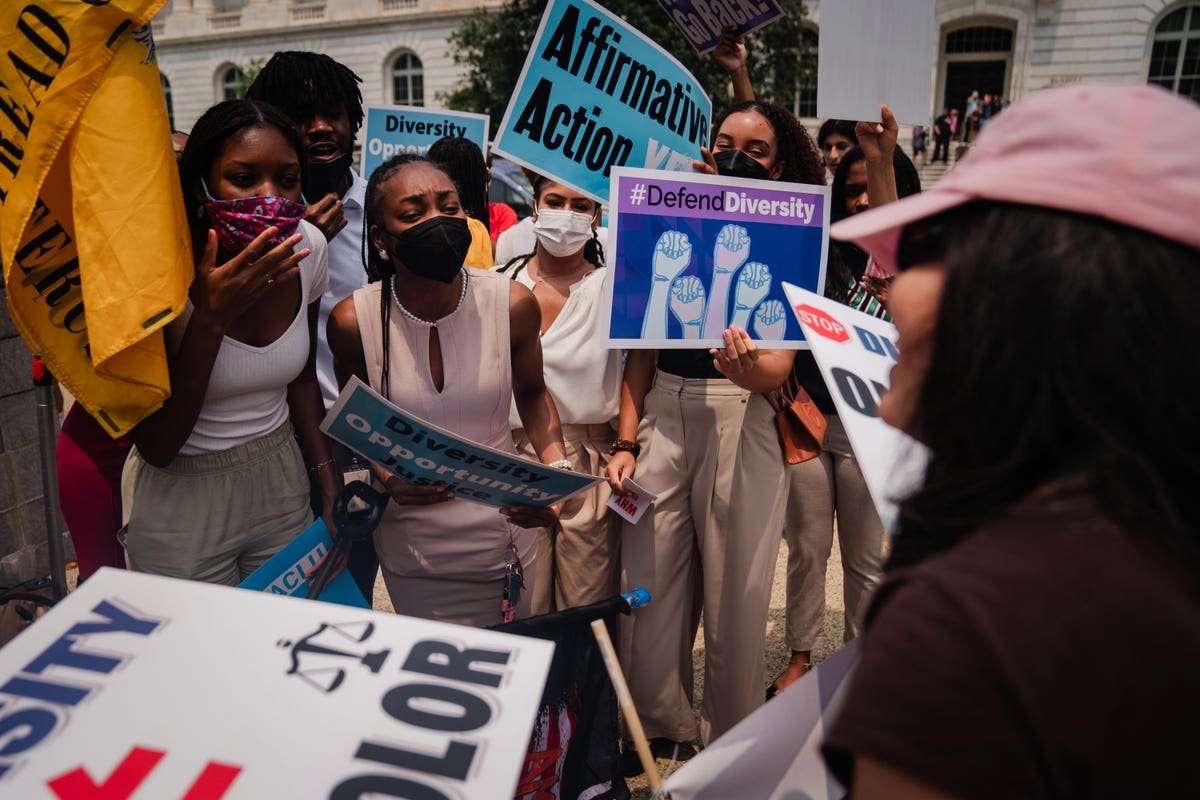
The Supreme Court’s decision in Students for Fair Admissions, Inc. v. President and Fellows of Harvard College — the affirmative action ruling released on Thursday — will have significant impact on education and then other areas. Here are some of the implications according to a number of attorneys who spoke with me today.
Schools Face Big Changes
“These decisions today are going to dramatically change how most higher education institutions and a lot of K-through-12 school districts go about their admissions process and a lot of other diversity programs,” says Rob Duston, a partner in the higher education and labor and employment groups at law firm Saul Ewing.
Both Harvard and the University of North Carolina “employ a highly selective admissions process to make their decisions,” said background material listed before the opinion written by Chief Justice John Roberts. Both the schools considered race in their decisions.
But not anymore.
“Harvard’s and UNC’s admissions programs violate the Equal Protection Clause of the Fourteenth Amendment” as well as requirements of Title VI of the Civil Rights Act of 1964, said the Roberts opinion. Affirmative action as it has existed in school admissions is over.
“You can’t credit everyone who self-identifies as black as someone who has overcome diversity,” Duston says. “[Race] must be something the student raises and demonstrates. Somehow, when you’re looking at the whole person, you can look at their whole experience, but you can’t give a plus up just by their skin color.”
Tracking students by race isn’t illegal, “but tracking may be evidence that you want to select based on race,” explains Duston. The opinion went ever further, though. “The Supreme Court said it was skeptical not only about the tracking. They were skeptical about the actual categories themselves and the ways of subdividing people, all of which have been used by the federal government, numerous agencies, numerous state agencies.” That may set off a flurry of legal activity in many areas.
There could also well be the impact that California’s Proposition 209 in 1996, which ended affirmative action in the state, had. “Berkeley and UCLA, the most selective public universities in the state, saw a declines in Black and Hispanic enrollment of about 40% immediately the year after the Proposition was implemented,” Zachary Bleemer, an incoming assistant professor of economics at Princeton University, told NPR.
Businesses May Be Okay
Many news stories have mentioned potential problems for businesses and diversity, equity, and inclusion (DEI) programs, but they “fail to mention is that race conscious actions in business are already severely limited,” as Kathryn Youker, director of the Economic Justice Project of the Lawyers’ Committee for Civil Rights Under Law, says.
The part of the Civil Rights Act of 1964 that pertains to business, Title VII, is far stricter than Title VI. “Employers have an affirmative duty to avoid practices that have negative impact on any covered group,” she adds. That includes hiring practices. The difference is that corporate DEI programs don’t typically include decision making, even though many people assume that race is used as part of the hiring choice.
“They can consider race, they can be conscious of race, they can design programs to achieve the goals of DEIA, up until the point they made employment decisions,” Youker says.
But an indirect impact can also have consequences. Alyesha Dotson, co-chair of the EEO and diversity practice group at labor and employment law firm Littler, points to the dissent by Associate Justice Elena Kagan. “Her concern was if we do away with race as a factor for the election of students, what does that mean for our long-term talent pipeline,” says Dotson. It might be that in some industries there won’t be as diverse a pool of candidates “and employers 20 years down the line may not have as diverse a set of candidates.”
“In the short term, employers can get creative with their diversity, equity, and inclusion program might consider a mentorship for middle school and high school students,” Dotson says. Will that be enough to restore a move toward fairer and more inclusive industries? No way to know.
And Expect Challenges
“One indirect impact is we’re probably going to see increased challenges to workplace DEI and affirmative action programs,” says Andrew Turnbull, a partner in the employment and labor group at Morrison & Foerster. When people hear that the Supreme Court addressed affirmative action, there will be some to assume that education and employment are identical and “may say, ‘Why is my employer doing this?’ I think you’ll see an increase in reverse discrimination cases.”
“There is language in the decision the court used that will likely be used by groups out here that are trying to remove or significantly diminish DEI programs,” adds Michelle Crockett, partner and firm’s deputy CEO and chief diversity officer at law firm Miller Canfield.
“We all know how this is going to go because we have examples of what has happened in jurisdictions where anti-affirmative actions have happened,” Crockett says, referring to the Proposition 209 effects. “That chilling effect that it may have on corporations moving forward with their DEI actions is real.”
Read the full article here