




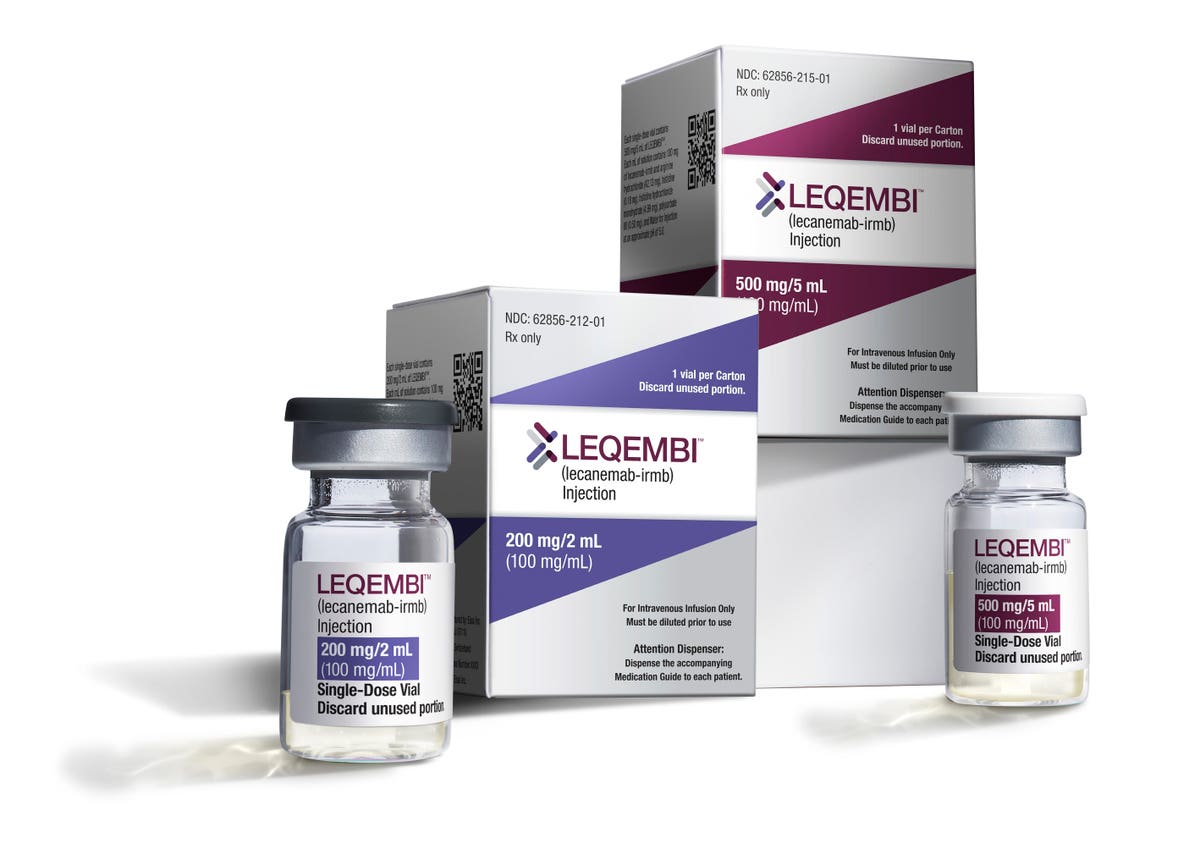
The Food and Drug Administration (FDA) has granted final approval to the anti-Alzheimer’s drug lecanamab, marked as Leqembi by drugmakers Eisai and Biogen
BIIB
What does it do? In a formal phase 3 trial, Leqembi was shown to slow the progression of memory loss and cognitive impairment in patients with early-stage Alzheimer’s disease by about 27 percent over an 18-month period.
How does it work? Leqembi is one of a class of drugs known as monoclonal antibodies. In a trial, it reduced the amount of a material called amyloid beta that builds up in the brains of people with Alzheimer’s disease. While this plaque is associated with Alzheimer’s, scientists strongly disagree about whether it causes the disease, either alone or in combination of other brain changes.
What it doesn’t do? It does not reverse brain damage caused by Alzheimer’s or stop the disease from getting worse. It does slow the progression of Alzheimer’s. Until we see further trial results, it is not possible to know if the benefits continue and at what pace, after 18 months. There is no evidence that Leqembi benefits people with later stage Alzheimer’s. Nor is there any evidence that it benefits patients with any of the many other forms of dementia, such as vascular dementia, frontal-temporal dementia, or Lewy-Body dementia.
How do you know if you are eligible to take Leqembi? You first need a diagnosis of early-stage memory loss caused by Alzheimer’s disease. You also must be screened to confirm you have a build-up of amyloid beta. That requires either a PET scan or a spinal tap. Patients must also be tested for a gene known as APOE4 that may make the drug especially risky. And they must receive regular MRI imaging while they take the drug to be sure they are not experiencing certain known side effects such as amyloid-related imaging abnormalities (ARIA) which results in brain swelling and, less commonly, bleeding in their brain.
Brain bleeds? Leqembi is not without risks. Three patients who participated in the trial died from brain bleeds that likely are associated with the drug. These hemorrhages appear to be a frequent side effect, though in most cases they are minor. People on blood thinners, those with two copies of the gene APOE4, and those with a common but often undiagnosed Alzheimer’s-related condition known as cerebral amyloid angiopathy (CAA) may be especially at risk.
How do you take it? Patients will have to travel to a clinic, hospital, or a doctor’s office every two weeks to receive infusions, which will take about an hour. The drug must be taken as long as it shows clinical benefit. At first, the drug will be administered mostly at academic medical centers or specialty clinics.
What will it cost? The drugmakers say they will price Leqembi at about $26,500 annually. In June, Medicare said it will pay for the drug but only for patients with early-stage Alzheimer’s who are enrolled in a drug trial or whose doctors participate in a registry, a national database that will track the progress of people taking the drug. The Veterans Administration will pay for those age 65 or older who are clinically eligible. Most commercial insurance is likely to follow Medicare’s lead.
Even if Medicare covers Leqembi, Medicare beneficiaries may still have to pay a significant share of the cost. Because Leqembi is a Part B drug, not a more common Part D drug, many Medicare patients will owe 20 percent of the cost out-of-pocket. That adds up to more than $5,000 annually. In addition, the initial PET scan generally will not be paid by Medicare, and, while costs vary widely, an outpatient scan averages about $2,500. Certain Medicare Supplement (Medigap) plans and Medicare Advantage (MA) plans may cover at least some of those out-of-pocket costs.
Are other new drugs coming? The FDA is expected to approve other monoclonal antibodies over the next year. Like Leqembi, they clear away the plaques in the brains of people with Alzheimer’s. Eli Lilly has requested FDA approval for a similar monoclonal antibody called donanemab. In the future, researchers hope to see combination drugs that reduce both amyloid beta and another possible cause of Alzheimer’s, the abnormal build-up of another protein called tau.
What are the policy implications of these drug? The Kaiser Family Foundation estimates Leqembi could increase annual Medicare spending by $9 billion annually. That likely will result in higher premiums and higher taxes (about two-thirds of Medicare Part B costs are funded by general tax revenues).
While last year Congress gave Medicare limited authority to negotiate prices directly with drugmakers, Leqembi will not be subject to that process for another 13 years. Until we know more about the benefits and risks, how many people with Alzheimer’s actually use the drug, and whether it can reduce other health care costs, it is impossible to know the long-run costs to the Medicare program.
Leqembi and drugs like it hold the promise of at least temporarily slowing the progression of Alzheimer’s disease. But they come with known risks and, based on evidence so far, will provide only limited help to a fraction of people living with dementia. Before deciding what to do, learn as much as you can and talk to a trusted clinician.
Read the full article here