




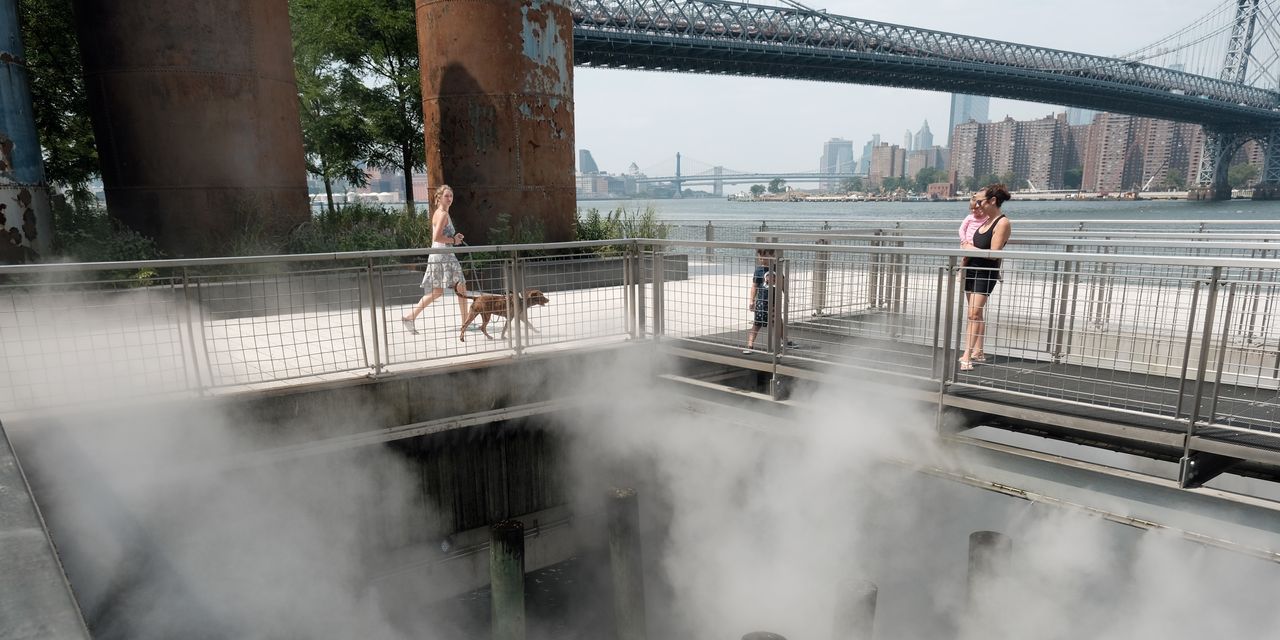
Around 150 million people, or about half the U.S. population, are under heat alerts after extreme temperatures even for July pushed into the highly populated I-95 corridor in the Eastern U.S. on Friday.
When you add in current flood issues, nearly 200 million people in the U.S., or about 60% of the population, are under a heat advisory or flood warning or watch and have been since Thursday, according to the National Weather Service.
Extreme temps, with “real feel” numbers pushing above 100 degrees Fahrenheit, and flood events are tied to manmade climate change from burning fossil fuels like oil
CL00,
and gas
NG00,
but also to a boost from a warming El Niño, the recurring weather phenomenon whose latest impact, scientists say, is only beginning.
This July is different
More than 100 million Americans have routinely been under heat warnings over the past few weeks. And the globe overall has seen an unusually hot July.
The extreme-heat forecast persists just as the World Meteorological Organization and the European Union’s Copernicus Climate Change Service declared July 2023 the hottest month on record this week.
Even regular hot spots like Phoenix, Ariz., and parts of Texas have suffered under an unrelenting string of days when the mercury has been well above 100 degrees Fahrenheit, and “real-feel” factors including humidity make conditions even more brutal. Phoenix, where residents have received third-degree burns from sidewalks and pavement, will be the first major city in the U.S. to average 100 degrees for an entire month. It has seen a record 26 days — and counting — with highs above 115 degrees.
Read: Never mind global warming, ‘era of global boiling has arrived,’ warns U.N. head
Although much of the country does not cool much on normal summer nights, night temperatures are forecast to stay hotter than usual, prompting excessive heat warnings from the Plains to the East Coast.
Even relief has been limited. Moisture moving into the Southwest has cooled the southernmost counties of California and parts of southern Arizona some, but excessive heat warnings remain for much of the region.
Clearly, when it comes to heat and other weather extremes, we can’t afford to think of climate change as a problem for future generations to solve. The public should heed the current high-heat warnings and think about mitigating the impact ahead of time, say health experts and climate-change scientists.
Read: Why you, and your wallet, must get used to heatwaves
Who’s most at risk in high heat?
From 1979 to 2018, more than 11,000 Americans died from heat-related illness, according to the Environmental Protection Agency. And in a recent study, researchers concluded that heat-related deaths in the U.S. may be “substantially larger than previously reported.”
Soaring-mercury days may seem like one-off sweaty inconveniences that call for a frozen margarita if you can find one and an evening dip. But these days are becoming more frequent, and they exponentially impact the elderly, small children, underserved communities without access to air conditioning, as well as individuals with compromised health to begin with. People who work outdoors are also at higher risk than office-bound contemporaries.
Read: Biden announces new measures to protect workers from heat-related dangers across United States
Pregnant people face an elevated risk of heat-related illnesses, for example, because their bodies are working overtime to keep themselves and the growing fetus cool, the Center for Disease Control and Prevention says.
Expectant mothers are also more likely to be dehydrated and produce less sweat, which is dangerous because sweating is a key way the body cools itself. Additionally, people exposed to extreme heat during pregnancy are at increased risk of developing high blood pressure and preeclampsia, a potentially fatal pregnancy complication, points out Samantha Harrington, writing for the Yale University Climate Connections publication.
Extreme or relentless summer heat can also exacerbate poor air quality by trapping harmful pollutants close to the Earth’s surface and creating ground-level ozone. These pollutants can trigger respiratory issues in people with asthma and other lung diseases.
Learn to recognize the signs of heat illness.
Ounce of prevention
The National Weather Service has a quick. simple checklist to lower heat risk. But these measures only work when people respect how quickly heat-related illness can come on.
1. Never leave people or pets alone in a closed car, not even for a few minutes.
2. Drink plenty of water, and eat water-heavy fruit, starting early in the day. And drink even if you don’t feel thirsty.
3. Wear loose-fitting, light-colored clothing. Remember, sweating is helping.
4. Find relief, even for brief periods, in the air conditioning — or at the least, in the shade. Look out especially for construction workers, delivery drivers and others whose jobs keep them out in the heat.
The Associated Press contributed.
Read the full article here