




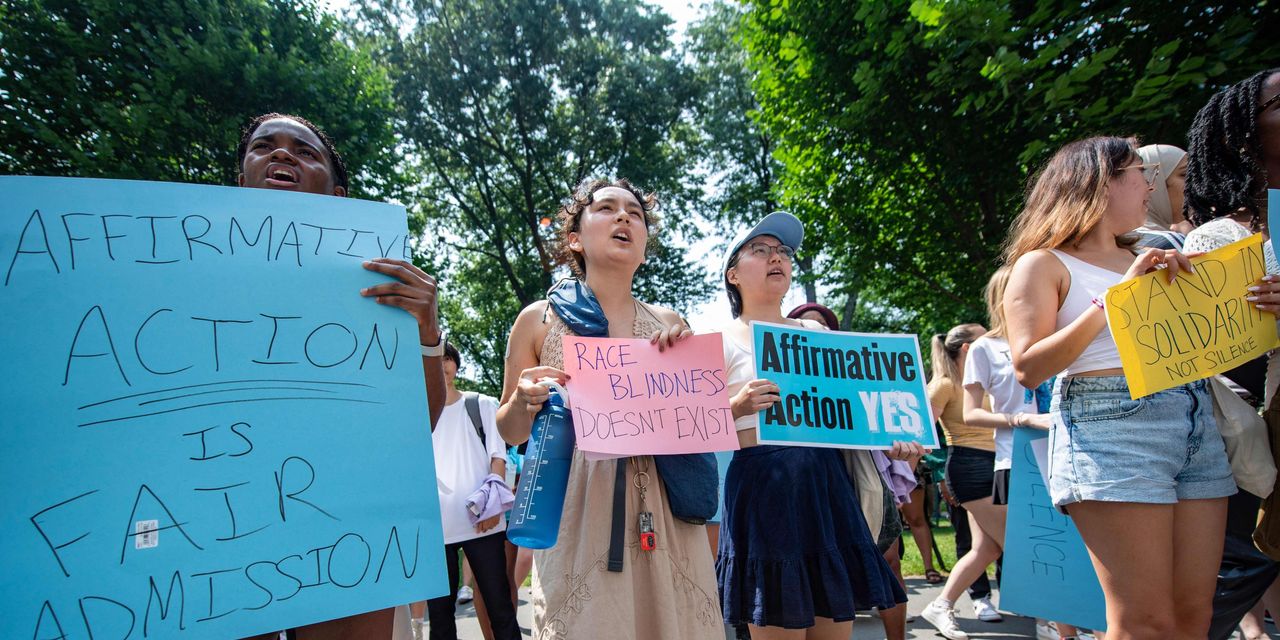
Despite the Supreme Court’s ruling banning affirmative action in college admissions this summer, colleges and universities can legally consider applicants’ backgrounds and experiences — including those related to their race — in admissions decisions, according to the Biden administration.
That’s one piece of guidance offered to schools by attorneys at the Department of Education and the Department of Justice Monday, part of a broader set of documents advising institutions how they can maintain diverse student bodies following the court’s decision.
Secretary of Education Miguel Cardona told reporters Monday that he hopes the resources “provide some clarity about the admissions practices to maintain racial diversity that remain lawful.”
He continued: “This moment demands [the same commitment] to equal opportunity and justice we saw from leaders at the height of the civil rights movement.”
After a decades-long battle over the use of race in college admissions, the court’s conservative majority in June struck down race-conscious admissions policies at Harvard University and the University of North Carolina. In the lead-up to and in the wake of the decision, college leaders and other higher-education stakeholders have worried about how they can maintain racially diverse student bodies without affirmative action. In addition, advocates for diversity in higher education have worried that schools might react too aggressively to the ruling in order to mitigate their legal risk.
Hours after the decision, President Joe Biden announced that his administration would provide colleges with clarity on how they could continue to promote diversity while staying within the bounds of the court’s ruling. Monday’s guidance is one part of that plan.
In the weeks since the ruling, some schools have been cautioned by state leaders against using race in certain contexts, for example as part of scholarship programs. The Biden administration documents don’t discuss those situations directly, and on a call with reporters, a senior Department of Education official noted that the court’s decision didn’t address financial aid.
In the documents, attorneys from the Department of Education’s Office of Civil Rights and Justice Department’s Civil Rights Division detailed approaches they say schools can still use legally.
Considering race as long as it’s tied to the applicant’s experience
In its decision, the court ruled that colleges couldn’t give students a boost in admissions simply based on the racial-identification box they might check on an application — but said they could consider “an applicant’s discussion of how race affected his or her life.”
What that means, according to the Biden administration: “Institutions of higher education remain free to consider any quality or characteristic of a student that bears on the institution’s admission decision, such as courage, motivation, or determination, even if the student’s application ties that characteristic to their lived experience with race,” officials wrote in the documents. That remains legal as long as any admissions benefit provided to the student is based on a student’s characteristics and experiences and not on their race, according to the guidance.
The documents released by the Biden administration provide some practical information about how that might play out in college admissions offices. For example, schools could consider details from a letter of recommendation indicating how a Latina student dealt with feelings of isolation at a largely white high school, or an applicant’s discussion of what it meant to be the first Black violinist in a city youth orchestra, according to the guidance.
Last month, one of the attorneys involved in drafting the documents, Kristen Clarke, assistant attorney general for civil rights at the Department of Justice, provided an example from her own life.
“Maybe that would be a university considering an essay from a Black student who discussed her interest in becoming a civil rights attorney after going on a field trip to a courthouse” to hear arguments in a landmark civil rights case, she said at a summit of higher-education leaders in July.
Targeting recruitment
Historically, when states have banned race-conscious admissions policies, colleges have looked to create a more robust pipeline of applicants from underserved communities in an attempt to maintain racial diversity in their schools. The idea is that if colleges encourage more students from underserved communities to apply, admissions officers will have a bigger pool of such students to choose from.
California voters decided to end affirmative action in 1996, and in the years since then, the University of California system has spent more than $500 million on programs to provide students at disadvantaged high schools with more college-preparation and college-planning resources.
The system billed these efforts as race-neutral, and their effects were relatively race-neutral as well. The programs helped drive an uptick in enrollment of low-income students and students who were the first in their families to go to college, according to a friend-of-the-court brief filed by the University of California in another affirmative-action case. Still, they weren’t as effective at changing the racial and ethnic makeup of the colleges and universities as race-conscious admissions policies were.
Since the Supreme Court decision, there have been questions about what kind of proxies schools could legally use to target students of color for recruitment. In the guidance, the Biden administration said colleges could be relatively explicit in focusing their recruitment efforts on these students.
“In seeking a diverse student applicant pool, institutions may direct outreach and recruitment efforts toward schools and school districts that serve predominantly students of color and students of limited financial means,” one document reads.
Changing admissions policies to enroll more students from other underrepresented groups
Officials wrote that nothing in the decision prevents schools from re-evaluating their practices to determine “which factors in a holistic admissions process most faithfully reflect institutional values and commitments.”
For example, schools may consider making an effort to enroll more students who receive Pell grants — funding the government provides to low-income students — and students who are the first in their families to go to college, according to the guidance. They could also drop requirements like application fees or a calculus prerequisite that may prevent disadvantaged students from successfully applying, officials wrote.
The guidance also offered another way schools could craft admissions policies that make it easier for students from underserved backgrounds to enroll: They could admit all students who meet a certain criteria — like a minimum grade-point average — or who are coming from community colleges or other types of schools that tend to serve low-income or otherwise educationally disadvantaged students.
Ending legacy and other admissions preferences that benefit well-off students
As part of evaluating their admissions practices in the wake of the decision, schools might consider whether admissions preferences for the children of donors “run counter to efforts to promote equal opportunities for all students in the context of college admissions,” officials wrote.
The court’s decision on affirmative action increased pressure on colleges to drop policies that give an admissions boost to students whose relatives attended a school. Already, a number of schools have dropped these policies.
Still, such policies remain common, and they tend to benefit well-off students. Recent research from economists at Harvard University and Brown University found that students in the top 1% of earnings distribution were twice as likely to enroll at certain highly selective universities as were middle-income students with similar test scores, in part because of the advantage some schools provide to legacy applicants.
Whether the Biden administration will take more aggressive steps to steer schools away from legacy preferences and other policies that disproportionately benefit wealthier students remains to be seen. The Department of Education said in July that it’s investigating a claim from a group of civil rights organizations about Harvard University’s approach to donor and legacy advantages in admissions.
Read the full article here