





By AJ Rivers, CFA, FRM, CAIA & Will Smith, CFA
As the US economy begins to feel the weight of the Federal Reserve’s rate hikes, investors have grown leery of US high-yield corporate bonds. On the surface, that makes sense. Historically, credit conditions soured when growth slowed. But instead of bracing for a wave of downgrades and defaults, we think income-seeking investors should embrace high yield. Here’s why.
Reason 1: Strong fundamentals late in the credit cycle
If the US economy enters and remains in a low-growth phase, the high-yield sector isn’t at great risk of a downturn. But the banking crisis has increased the odds of a hard landing.
At the brink of most slowdowns, corporate fundamentals are typically already weak. And it’s true that high-yield issuer fundamentals are beginning to weaken now. But they’re starting from an unusually strong position at this late stage of the credit cycle.
Today’s high-yield bond issuers are in much better shape financially than issuers entering past slowdowns, thanks in part to an extended period of uncertainty surrounding the coronavirus pandemic. This uncertainty led companies to manage their balance sheets and liquidity conservatively over the past few years, even as profitability recovered. As a result, leverage and coverage ratios, margins, and free cash flow improved. This relative strength in balance sheets means corporate issuers can withstand more pressure as growth and demand slow.
Prudent fiscal management isn’t the only reason the corporate universe is well-positioned to weather a storm. The default cycle triggered by the pandemic – with defaults peaking at 6.3% in October 2020 – effectively cleaned up the sector. The weakest companies defaulted and are now no longer part of the investable universe. The surviving companies were the strong ones.
That was less than three years ago. Since then, there simply hasn’t been enough time for the survivors to develop unhealthy financial habits. As a result, we expect the US default rate to remain low for the next 12 to 18 months – around 3% to 4%. Plus, the share of the high-yield bond market that is secured – 31% as of December 31, 2022 – is high by historical measures. That may translate into higher recovery rates for high-yield bonds in the event of default.
The pandemic-led wave of defaults and downgrades also strengthened the average quality of the high-yield market. Even as many of the lowest-rated high-yield bonds defaulted and fell out of indices, many of the lowest-rated investment-grade bonds fell into the high-yield market as fallen angels. Consequently, the quality of today’s high-yield market is unusually high, with BB-rated bonds currently comprising 49% of the market, versus 43% on average over the past 20 years.
That said, in our analysis, high-yield investors should favor higher-quality credits, be selective and pay attention to liquidity. Lower-rated credits are most vulnerable in an economic downturn. Investors may also want to be selective with high-yield bank loans, which are more vulnerable than high-yield bonds to a downturn, in our view.
Reason 2: Extended maturity runways
Extended maturity runways are also taking some financial pressure off high-yield issuers. Companies have focused on extending their maturity runways since the start of the pandemic. That means there’s no approaching maturity wall, where a large share of bond issues matures and issuers are compelled to procure new debt at prevailing rates. In fact, only 5% of the market will mature by the end of 2024, with the lion’s share of maturities coming between 2027 and 2033.
This is akin to opening a pressure valve as yields rise because gradual and extended maturities will slow the impact of higher yields on companies (Display). Today, the average high-yield coupon is 5.8% – significantly lower than the current yield to worst, at 8.5%.
An Extended Maturity Runway Takes Pressure off Issuers
Bloomberg US Corporate High Yield Index: Maturities
Barclays, Bloomberg, and AllianceBernstein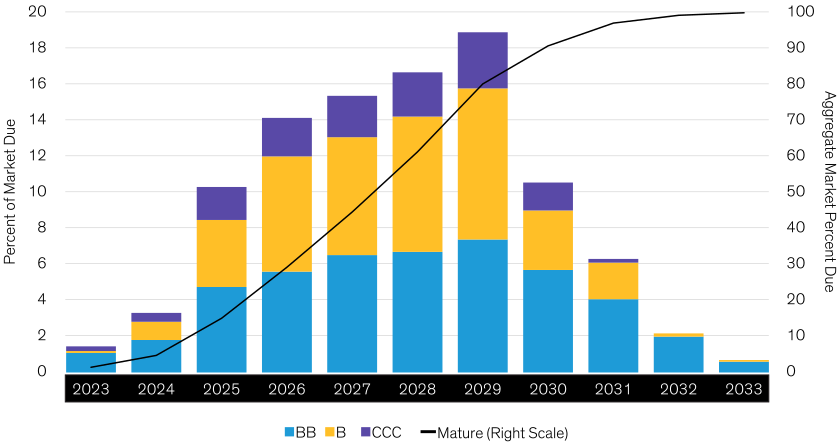
Past performance and historical analysis do not guarantee future results. As of March 31, 2023
Reason 3: High yield that’s truly high
Yields on high-yield corporate bonds are higher today than they’ve been in years, giving income-seeking investors a long-awaited opportunity to fill their tanks. What’s more, history shows that the US high-yield sector’s yield to worst has been an excellent proxy for its return over the following five years. In fact, US high yield has performed predictably, even through rough markets (Display).
Yield to Worst Has Historically Been a Strong Predictor of Future Returns
Bloomberg US Corporate High-Yield Index: Yield to Worst and Five-Year Forward Annualized Return (Percent)
Barclays, Bloomberg, and AB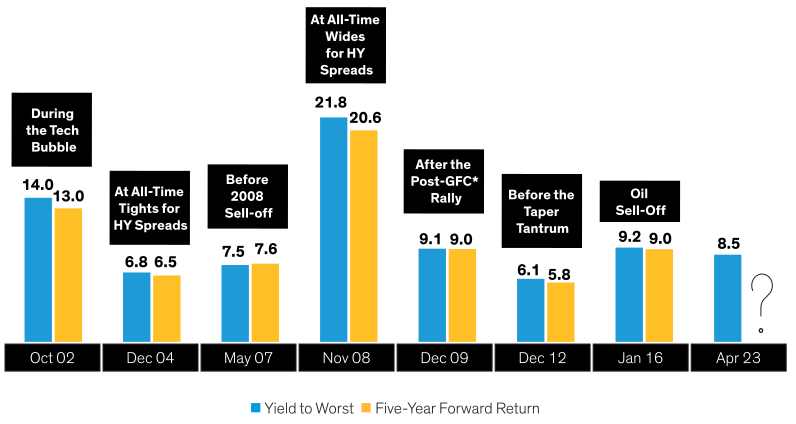
Past performance and current analysis do not guarantee future results.*GFC = Global Financial Crisis. As of April 30, 2023
The relationship between yield to worst and future five-year returns held steady even during the global financial crisis, one of the most stressful periods of economic and market turmoil on record. If an investor had bought a high yield in May 2007 at a yield-to-worst of 7.5% and held onto that investment for the next five years – riding out a 36% drawdown in the high-yield market – that investor would have earned 7.6% in total return on an annualized basis.
Why? High-yield bonds supply an income stream that few other assets can match. And when high-yield issuers call their bonds before they mature, they pay bondholders a premium for the privilege. This helps compensate investors for losses suffered when some bonds default.
Reason 4: Catching the rebound
Despite these favorable factors, many investors remain leery of jumping on the high-yield bandwagon when the economy may be on the brink of recession and spreads are trading around historical averages.
But sitting on the sidelines can be a costly mistake, as the yield give-up in the here and now is significant, and yield levels may be lower in the future. At any rate, it can be virtually impossible to time market entry to avoid loss and capture the rebound. High yield is among the most resilient asset classes and tends to rebound quickly after downturns. On average, since 2000, high yield rebounded from peak-to-trough losses exceeding 5% in just five months – and as few as two. And when it did rebound, it went big (Display). Over the 12 months following such losses, the US high-yield market returned 22% on average. Reluctant investors missed out.
Historically, High-Yield Drawdowns Have Been Brief, and Recoveries Swift
Bloomberg and AB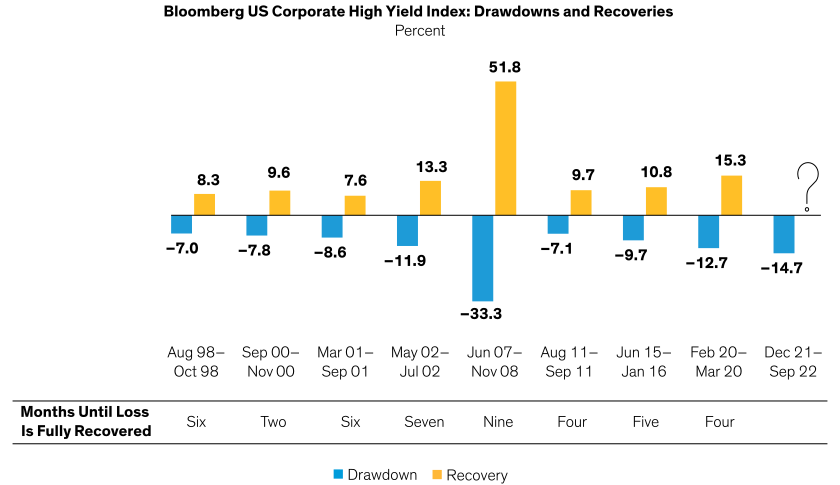
Past performance and historical analysis do not guarantee future results. Analysis uses monthly data. Drawdowns are defined as peak-to-trough losses bigger than 5%. As of March 31, 2023
Reason 5: De-risking an equity portfolio
Lastly, we think investors should consider an allocation to high-yield debt as a complement to an equity portfolio. Compared with equity drawdowns, high-yield drawdowns have historically been less severe, helping high yield provide downside mitigation in bear markets (Display). Equities have also taken longer to recover from drawdowns.
When High Yield Draws Down, Equities Draw Down More
Bloomberg and AB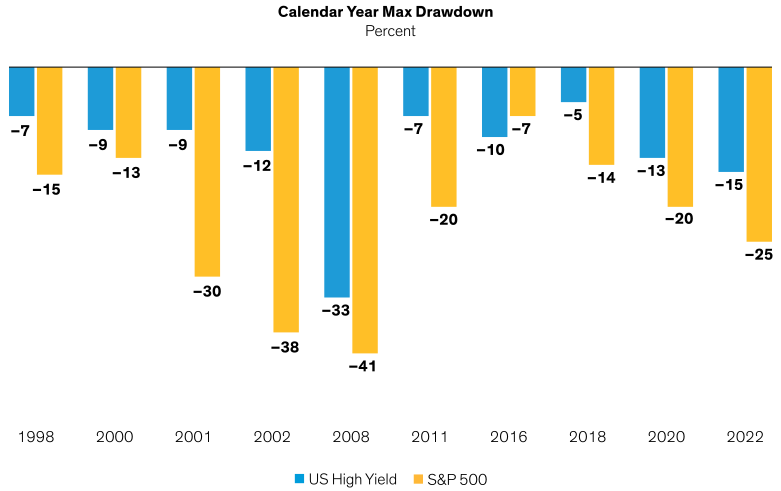
Past performance and current analysis do not guarantee future results. US High Yield is represented by the Bloomberg US Corporate High Yield Index. Analysis uses monthly data. Drawdowns are defined as peak-to-trough losses bigger than 5%. As of December 31, 2022
In fact, by shifting a modest allocation away from US equities and into US high yield, investors can boost risk-adjusted return potential – tamping down volatility without sacrificing too much return potential.
That’s why, even in the late stages of the credit cycle, we think high-yield bonds should play a role in the portfolios of income-seeking investors. From strong fundamentals to truly high yields, this resilient asset class can help investors meet their goals.
The views expressed herein do not constitute research, investment advice or trade recommendations and do not necessarily represent the views of all AB portfolio-management teams. Views are subject to change over time.
Original Post
Editor’s Note: The summary bullets for this article were chosen by Seeking Alpha editors.
Read the full article here