




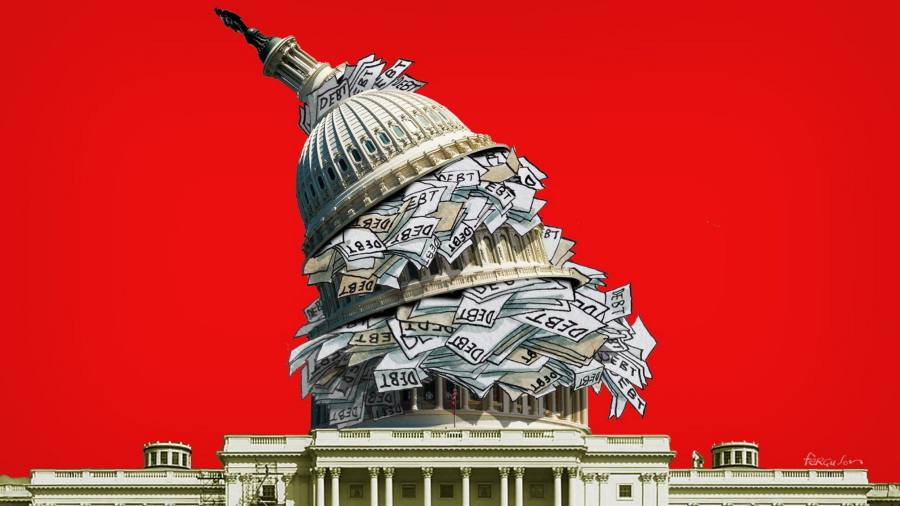
How is one to assess the possibility of a voluntary default by the world’s most important country? Is something as mad as this really likely to happen? What might be the consequences if it did? These questions are impossible to answer. This is not because it is a “black swan” — that is, unimaginable. A US default falls instead into a broad category of “known unknowns”, that is unforecastable, high-impact events. The financial crisis of 2007-09, the pandemic and Russia’s invasion of Ukraine were of this kind.
Such events are impossible to predict because of their rarity and the complexity of their causes. We do not know enough to predict when and in what form the next pandemic will emerge, when and where someone will start a war or if US politicians will destroy the credit built up by their country over centuries. Yet we know that such shocks do happen. They are a part of our reality.
So, what of this specific threat? It is not normal for a country to have a legislated budget and a separate authorisation for the debt that this budget entails. For the US, this was a product of the needs of war: prior to 1917, Congress had to authorise each individual loan. Up to now, the US debt ceiling has always been raised when needed. That has apparently happened some 90 times.
Sensible people would conclude the ceiling is a nonsense. But it is not an irrelevance. Increasingly, the Republicans regard the ceiling as leverage over spending but not, it must be stressed, over deficits caused by tax cuts. They were happy with the latter under George W Bush and Donald Trump. Thus, as an “explainer” from the Brookings Institution notes: “Over the last three decades, the limit has precipitated political battles during which some legislators have used the vote on the debt ceiling to try to slow the growth of federal spending.” This happened under Barack Obama in 2011 and under Joe Biden in 2021, before the debt ceiling was lifted to $31.4tn, where it is now. The need to lift it once again has become very urgent because the federal government might run out of cash in June.
Could default happen? The answer is “yes”. One reason is that the parties are vastly apart. The Republicans’ proposals would impose a 47 per cent cut in total real non-military, discretionary spending between 2024 and 2033. This is a huge gap to bridge, even if the mood music may be improving. The other reason is that key participants might feel that they lack an incentive to compromise. The Republicans are very fractious, some have extremely radical views and many seem to feel that even an economic disaster would hurt only the administration. Meanwhile, Democrats might feel that caving in on spending is too painful. In games of chicken such as this, collisions do happen.
Some hope that this can still be managed, at least for a while. The 2011 plan would have involved sustaining payments of interest and principal, but delaying payment to agencies, contractors, social security beneficiaries and Medicare providers. More radical proposals involve a trillion-dollar platinum coin or resort to the 14th amendment, which states: “The validity of the public debt of the United States, authorised by law . . . shall not be questioned.” With today’s Supreme Court, one must doubt whether this would work.
Think of all the people, institutions and countries that hold Treasuries as the world’s safest and most liquid assets. Even a short interruption in payments could be devastating to confidence, not just in Treasuries, but in capital markets. The possibility of a default may be disregarded as unreal. The experience of one would surely be all too real.
Beyond that, it would be a huge shock to trust in the US. Michael Strain of the conservative American Enterprise Institute asserts that, “Foreign leaders and global investors would look at the US and see a damning portrait. In this broken system, many elected officials do not respect the results of a presidential election and permit policy and ideological differences to stand in the way of honouring the government’s financial obligations. Investors would think harder about allocating capital to US entities, and America’s role as a beacon of liberal values — including free markets — would be severely undermined.” Quite simply, they would conclude that lunatics had taken over the asylum.
Even if the worst is avoided this time, repeated plays of this game of chicken make it cumulatively more likely that the crash will indeed happen. Glenn Hubbard, former head of the Council of Economic Advisers for Bush has made reasonable suggestions. What is needed is indeed a long-term solution, in which debt ceiling theatrics are replaced by coherent long-term budgeting. The current trajectory of US debt makes such proposals necessary.
Yet, against this is the fact that efforts by Democratic presidents, such as Bill Clinton and Obama, to lower prospective deficits have merely allowed Republicans to slash taxes when they returned to power. Given this, will there be the political will to put the needs of the country above partisan advantage? Nor is this an equal failure. The Republicans are heavily to blame. They are using threats of default to achieve cuts in spending and taxes, rather than in deficits, for which they have been unable to secure decisive electoral victories.
In the end, “It is the politics, stupid”. The only reason why a default is conceivable is the depth of disagreement in the country and so in Congress. If the US were less divided, the debt ceiling would not matter. In today’s divided US, it does. So long as these divisions continue, so will the threat of a default. Even if a temporary agreement is reached, the threat is likely to return soon.
Follow Martin Wolf with myFT and on Twitter
Read the full article here