




“You hope it doesn’t happen, but hope is not a strategy – so you prepare for it,” Brian Moynihan, CEO of Bank of America, the nation’s second-biggest lender, said in a television interview.
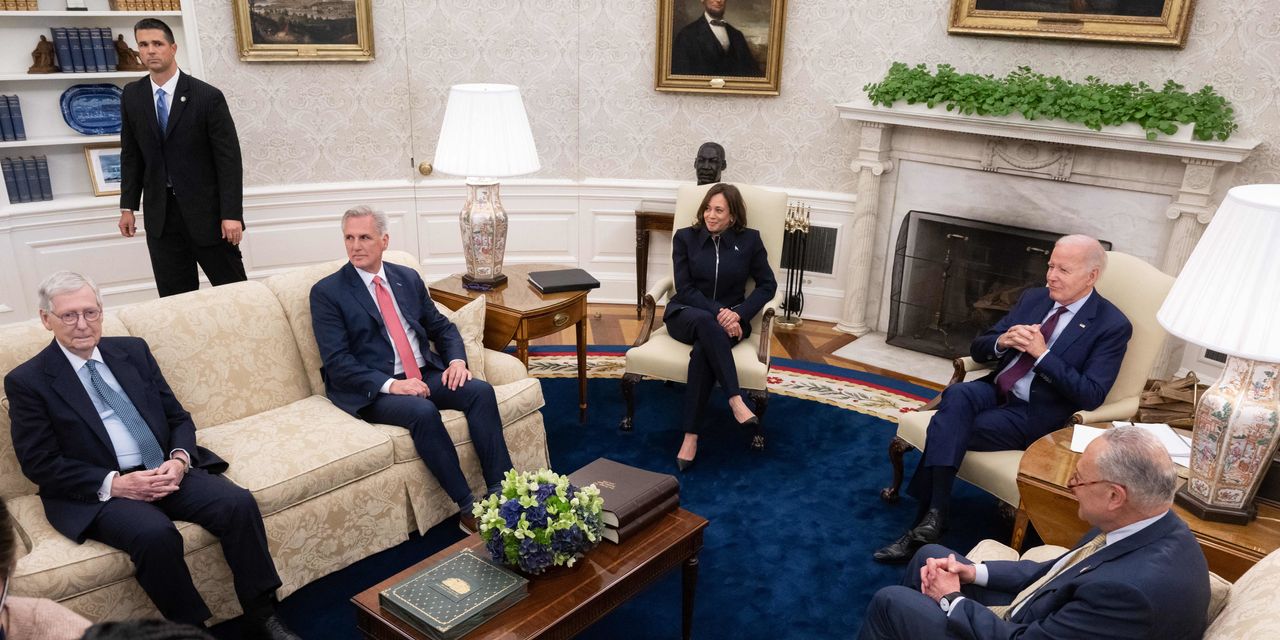
The doomsday planning is a reaction to a lack of progress in talks between President Joe Biden and House Republicans over raising the $31.4 trillion debt ceiling. Without an increase in the debt limit, the U.S. can’t borrow more money to cover its bills — all of which have already been agreed to by Congress — and in practical terms that means a default.
What happens if a default occurs is an open question, but economists — including me — generally expect financial chaos as access to credit dries up and borrowing costs rise quickly for companies and consumers. A severe and prolonged global economic recession would be all but guaranteed, and the reputation of the U.S. and the U.S. dollar
DX00,
as beacons of stability and safety would be further tarnished.
“ Markets overtaken by these emotions are chaotic and leave lasting economic scars. ”
But how do you prepare for an event that many expect would trigger the worst global recession since the 1930s?
Jamie Dimon, who runs JPMorgan Chase
JPM,
the biggest U.S. bank, told Bloomberg he’s been convening a weekly war room to discuss a potential default and how the bank should respond. The meetings are likely to become more frequent as June 1 — the date on which the U.S. might run out of cash — nears.
Dimon described the wide range of economic and financial effects that the group must consider, such as the impact on “contracts, collateral, clearing houses, clients” — basically every corner of the financial system — at home and abroad. “I don’t think it’s going to happen — because it gets catastrophic, and the closer you get to it, you will have panic,” he said.
That’s when rational decision-making gives way to fear and irrationality. Markets overtaken by these emotions are chaotic and leave lasting economic scars.
Banks haven’t revealed many of the details of how they are responding, but we can glean some clues from how they’ve reacted to past crises, such as the financial crisis in 2008 or the debt ceiling showdowns of 2011 and 2013.
Read: Bond holders have more to fear from the Fed than the debt-ceiling standoff
One important way banks can prepare is by reducing exposure to Treasury securities — some or all of which could be considered to be in default once the U.S. exhausts its ability to pay all of its bill. All U.S. debts are referred to as Treasury bills or bonds.
The value of Treasurys is likely to plunge in the case of a default, which could weaken bank balance sheets even more. The recent bank crisis, in fact, was prompted primarily by a drop in the market value of Treasurys due to the sharp rise in interest rates over the past year. A default would only make that problem worse, with close to 190 banks at risk of failure as of March 2023.
Another strategy banks can use to hedge their exposure to a selloff in Treasurys is to buy credit default swaps, financial instruments that allow an investor to offset credit risk. Data suggests this is already happening, as the cost to protect U.S. government debt from default is higher than that of Brazil, Greece and Mexico, all of which have defaulted multiple times and have much lower credit ratings.
But buying credit default swaps at ever-higher prices limits a third key preventive measure for banks: keeping their cash balances as high as possible so they’re able and ready to deal with whatever happens in a default.
Keeping the financial plumbing working
Financial industry groups and financial regulators have also gamed out a potential default with an eye toward keeping the financial system running as best they can.
The Securities Industry and Financial Markets Association, for example, has been updating its playbook to dictate how players in the Treasury market will communicate in case of a default.
And the Federal Reserve, which is broadly responsible for ensuring financial stability, has been pondering a U.S. default for over a decade. One such instance came in 2013, when Republicans demanded the elimination of the Affordable Care Act in exchange for raising the debt ceiling. Ultimately, Republicans capitulated and raised the limit one day before the U.S. was expected to run out of cash.
One of the biggest concerns Fed officials had at that time, according to a meeting transcript recently made public, is that the U.S. Treasury would no longer be able to access financial markets to “roll over” maturing debt. While hitting the current ceiling prevents the U.S. from issuing new debt that exceeds $31.4 trillion, the government still has to roll existing debt into new debt as it comes due. On May 15, for example, the government issued just under $100 billion in notes and bonds to replace maturing debt and raise cash.
The risk is that there would be too few buyers at one of the government’s daily debt auctions — at which investors from around the world bid to buy Treasury bills and bonds. If that happens, the government would have to use its cash on hand to pay back investors who hold maturing debt.
That would further reduce the amount of cash available for Social Security payments, federal employees wages and countless other items the government spent more than $6 trillion on in 2022. This would be nothing short of apocalyptic if the Fed could not save the day.
To mitigate that risk, the Fed said it could could immediately step in as a buyer of last resort for Treasurys, quickly lower its lending rates and provide whatever funding is needed in an attempt to prevent financial contagion and collapse. The Fed is likely having the same conversations and preparing similar actions today.
A self-imposed catastrophe
Ultimately, I hope that Congress does what it has done in every previous debt ceiling scare: raise the limit. These contentious debates over lifting it have become too commonplace, even as lawmakers on both sides of the aisle express concerns about the growing federal debt and the need to rein in government spending. Even when these debates result in some bipartisan effort to rein in spending, as they did in 2011, history shows they fail, as energy analyst Autumn Engebretson and I recently explained in a review of that episode.
That’s why one of the most important ways banks are preparing for such an outcome is by speaking out about the serious damage not raising the ceiling is likely to inflict on not only their companies but everyone else, too. This increases the pressure on political leaders to reach a deal.
Going back to my original question, how do you prepare for such a self-imposed catastrophe? The answer is, no one should have to.
John W. Diamond is director of the Center for Public Finance at the Baker Institute, Rice University. This article is republished from The Conversation under a Creative Commons license. Read the original article.
More: Does it matter if Social Security checks are delayed?
Also read: McCarthy says 2nd debt-ceiling meeting was ‘a little more productive,’ while Biden says he’s optimistic afterward
Read the full article here