




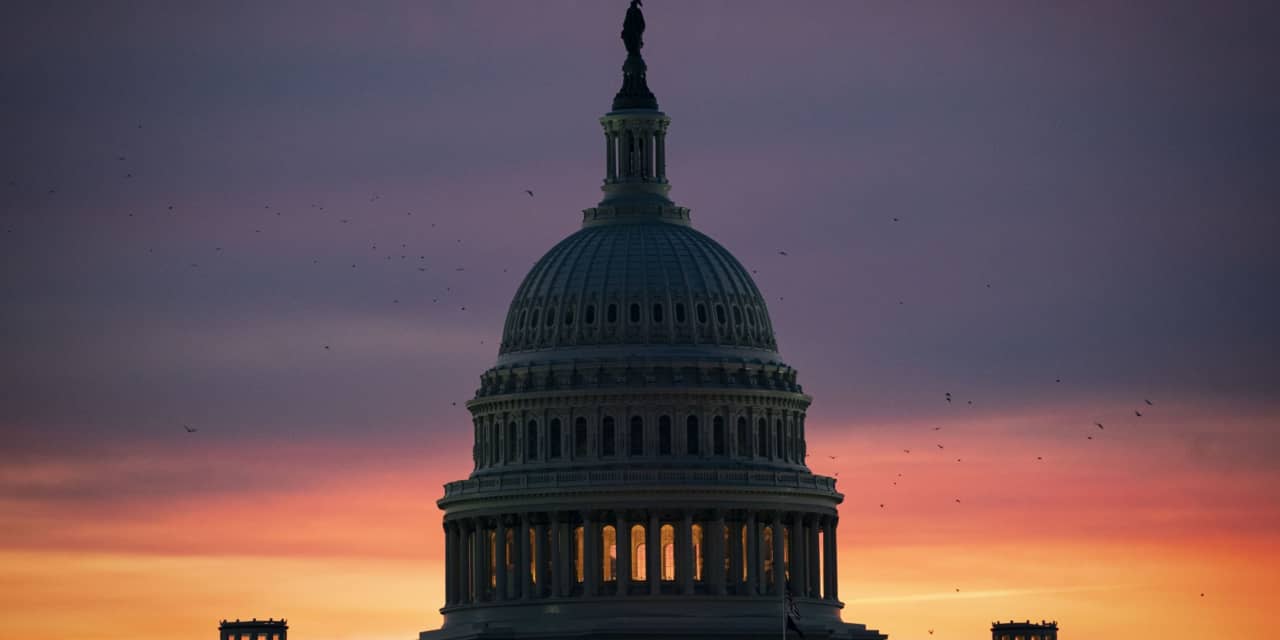
Congress has less than two weeks left to settle on a budget for the U.S. federal government before its Oct. 1 deadline—an issue that’s likely to dominate headlines and the political conversation. Investors shouldn’t overreact. This shutdown too shall pass.
“We’ve got a good strong economy and creating something that…could cause a loss of momentum is something we don’t need to risk at this point,” Treasury Secretary Janet Yellen told CNBC on Monday, responding to a question about a potential government shutdown.
As far as investors are concerned, government shutdowns tend to be something stocks can shrug off without much drama. Defense firms, some healthcare companies, and other government contractors are the most directly affected—but for the broader market, the direction of corporate earnings, interest rates, and other macro factors are more consequential.
“Government shutdowns tend to be high profile though low-impact market events,” wrote Truist Advisory Services’ co-chief investment officer and chief market strategist Keith Lerner on Tuesday. “While uncertainty around these events tends to heighten investor angst and adds to short-term market volatility, the historical evidence suggests a minimal lasting market impact.”
There have been 20 federal-government shutdowns since 1976, with the longest being the 2018-2019 shutdown which dragged on for 34 days. The average has lasted for only eight days.
According to data from Lerner, the
S&P 500
has been higher during 10 of those shutdowns and lower during the other 10. Its average return is exactly 0.0% for all shutdowns since 1976.
A one-month continuing resolution to start the federal government’s fiscal year is also possible, which would give Congressional negotiators more time to hammer out a compromise but sets up a new shutdown threat on Nov. 1—extending the uncertainty and adding to the short-term market volatility.
“It’s conceivable that there are multiple shorter federal shutdowns in FY24, and we still assess 25% odds of full-year continuing resolutions, which result in FY24 appropriations at 99% of FY23,” wrote Capital Alpha’s Byron Callan, who covers the defense sector, last week. He notes that Department of Defense personnel are set to be paid on Oct. 13—strong motivation to reach a resolution by then.
There can still be a real—or perceived—economic impact in the short term.
Goldman Sachs
economists estimate that every week that the federal government is shut down subtracts about 0.2 percentage points from gross-domestic product growth, although that economic activity returns once the government reopens.
There’s another wild card this time that relates to monetary policy. The Federal Reserve is in the late stages of its tightening campaign and is weighing its moves in real time. A government shutdown would leave the Fed flying blind, in the absence of official statistics from federal agencies.
The first major data release to be affected would be the September jobs report, scheduled for Oct. 6. Next up would be the September consumer price index on Oct. 12.
Fed officials have other sources of information they can use to keep an eye on the economy. Those include state-gathered data, the monthly ADP report on private-sector employment, and nongovernment surveys like the purchasing managers’ indexes. But those don’t present nearly as complete a picture as official data.
The Federal Open Market Committee will announce its next interest-rate decision on Nov. 1. What’s a “data-dependent” Fed to do when there’s no timely data? Likely sit on the sidelines and wait.
“Such an eventuality would only exacerbate the perennial concerns that monetary policy is set using only the benefit of the rearview mirror,” wrote Ian Lyngen, head of U.S. rates strategy at BMO Capital Markets, on Wednesday. “In such a scenario, items would be further away than they appear—once the economic updates eventually return.”
Futures markets are pricing in roughly a one-in-three likelihood of a quarter-point rate increase on Nov. 1, according to the CME FedWatch Tool. A prolonged government shutdown could drive those odds lower.
Write to Nicholas Jasinski at [email protected]
Read the full article here