




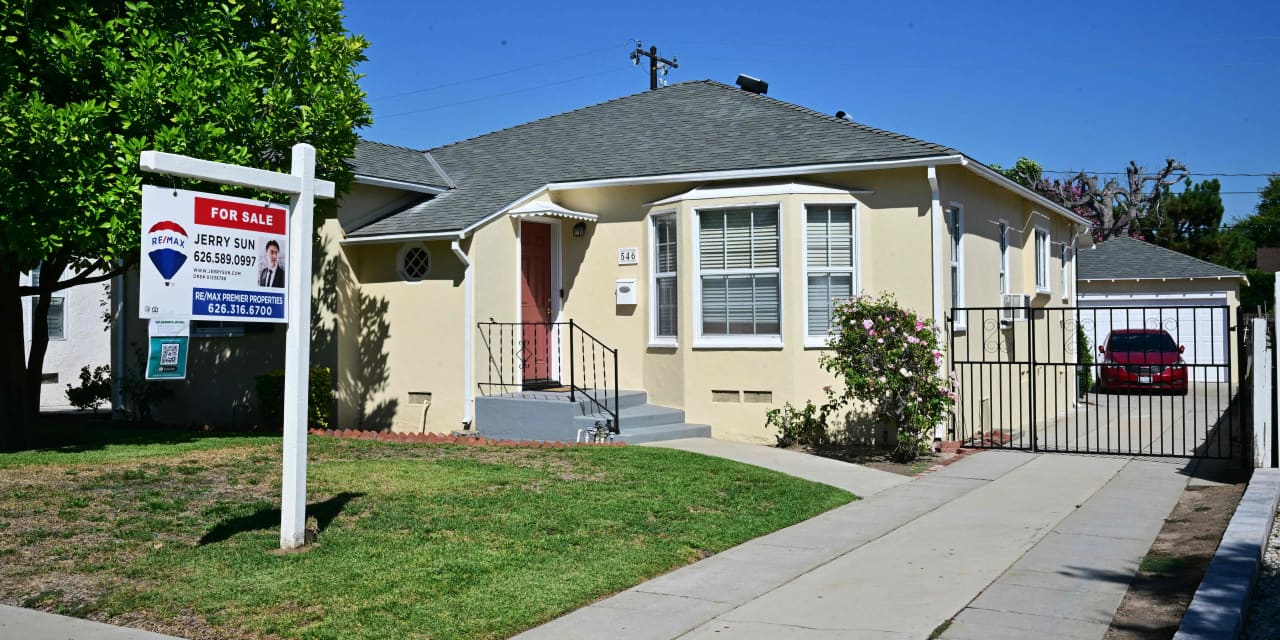
Mortgage rates rose to the highest level in nearly 23 years this week, further driving up the costs of homeownership. And rates may march even higher.
After sinking to historic lows during the pandemic’s early years, mortgage rates measured weekly by
Freddie Mac
have been above 7% since mid-August. The average 30-year fixed mortgage rate increased to 7.31% this week, its highest level since December 2000, and the widely followed metric’s third multidecade high of the year.
“Unlike the turn of the millennium, house prices today are rising alongside mortgage rates, primarily due to low inventory,” Sam Khater, Freddie Mac’s chief economist, said in a statement. “These headwinds are causing both buyers and sellers to hold out for better circumstances.”
Other sources of mortgage rates already recorded new highs in recent days: The Mortgage Bankers Association said Wednesday that its measure of conforming 30-year fixed mortgage rates last week gained 0.1 percentage point to 7.41%, the highest rate since December 2000. Daily data show rates have climbed since then: the 30-year fixed rate measured by Mortgage News Daily’s survey rose as high as 7.65% this week. The gains came as the 10-year Treasury yield, with which mortgage rates often move, surged over the past week to end Wednesday at its highest level since October 2007. The yield was gaining Thursday morning, to 4.634%.
More increases could be looming. Lawrence Yun, the National Association of Realtors’ chief economist, said earlier this month that mortgage rates could reach 8% in the short-term. He added that he expects mortgage rates to retreat some by next spring, the time of year when buyers typically begin to shop for a home.
Rising mortgage rates are handing a punch to affordability: the average buyer of the median home in the third quarter would need to devote roughly 35% of their wages to the purchase, according to a Thursday report by property data company Attom Data Solutions. That’s the greatest share since 2007.
Higher rates cut into contract signings for both new and previously owned homes in August, data suggest. New home sales, a measure of contract signings to buy newly constructed homes, dropped 8.7% in August from the month prior, government data released earlier this week show.
Pending home sales, a measure of contract signings for previously owned homes, also fell in August, dropping 7.1% from the month prior, the National Association of Realtors said Thursday. “It’s clear that increased housing inventory and better interest rates are essential to revive the housing market,” Yun said in a statement.
Every one-percentage point increase in mortgage rates roughly prices an additional three million households out of the housing market, the National Association of Realtors’ Yun told Barron’s. “Of course, not all three million are in the market to buy,” he added. “We further estimate that a one percentage point rise in mortgage rates cut home sales by 250,000 to 300,000 on an annualized basis.”
Data from the mortgage bankers group shows that applications for home purchase loans has remained near its 28-year low set in early September. “Given that we’re already at 20-something year lows, I don’t know if that could get any worse—because we have an affordability issue, and we have an inventory issue,” says Joel Kan, the association’s deputy chief economist, citing the low level of existing homes for sale that has kept that side of the market competitive through much of this year.
Should mortgage rates increase further, that doesn’t necessarily mean home prices will fall, says the National Association of Realtors’ Yun. “Prices would stay stable, especially given the inventory shortage, which could intensify until an economic recession and job losses forced sales,” the economist says.
The housing market broadly may not have much further to fall—but newly built homes, a previous bright spot, could suffer. Higher rates drove some of the decline in August’s new home sales, National Association of Home Builders Chief Economist Robert Dietz wrote.
“While some builders were able to offset that effect via mortgage rate buydowns, rates moved higher this month, suggesting the pace of new home sales will weaken further for September,” the economist wrote.
“While some builders were able to offset that effect via mortgage rate buydowns, rates moved higher this month, suggesting the pace of new home sales will weaken further for September,” National Association of Home Builders Chief Economist Robert Dietz wrote on Wednesday.
That’s bad news for the stocks, a team of UBS Equity Strategy analysts wrote in a Wednesday note. “Home builders’ ability to offer discounted prices and rate buy-downs for new builds has started to wane, home builder sentiment has fallen, housing starts/permits have softened, and relative earnings momentum is rolling over,” the analysts wrote. “Home builders also appear vulnerable to further valuation compression in a more volatile macro environment, with [price-to-book] still well above the long-term range and margins peaking.”
A mix of headwinds and tailwinds are likely to send housing costs into a “holding pattern” through the rest of the year, says Attom CEO Rob Barber. “Costs could rise further if mortgage rates increase again,” Barber said. “But home values usually flatten out or dip by small amounts from the third to the fourth quarter of each year—commonly one to four percent—as the annual peak buying season ends.”
Inflation and stock market declines could put further pressure on buyers’ budgets, cutting back on demand and tempering price increases, Barber adds. “However, none of those factors are firmly rooted at the moment,” he says. “A notable shift in any or all could push the affordability trend up or down by more than small amounts.”
Write to Shaina Mishkin at [email protected]
Read the full article here