




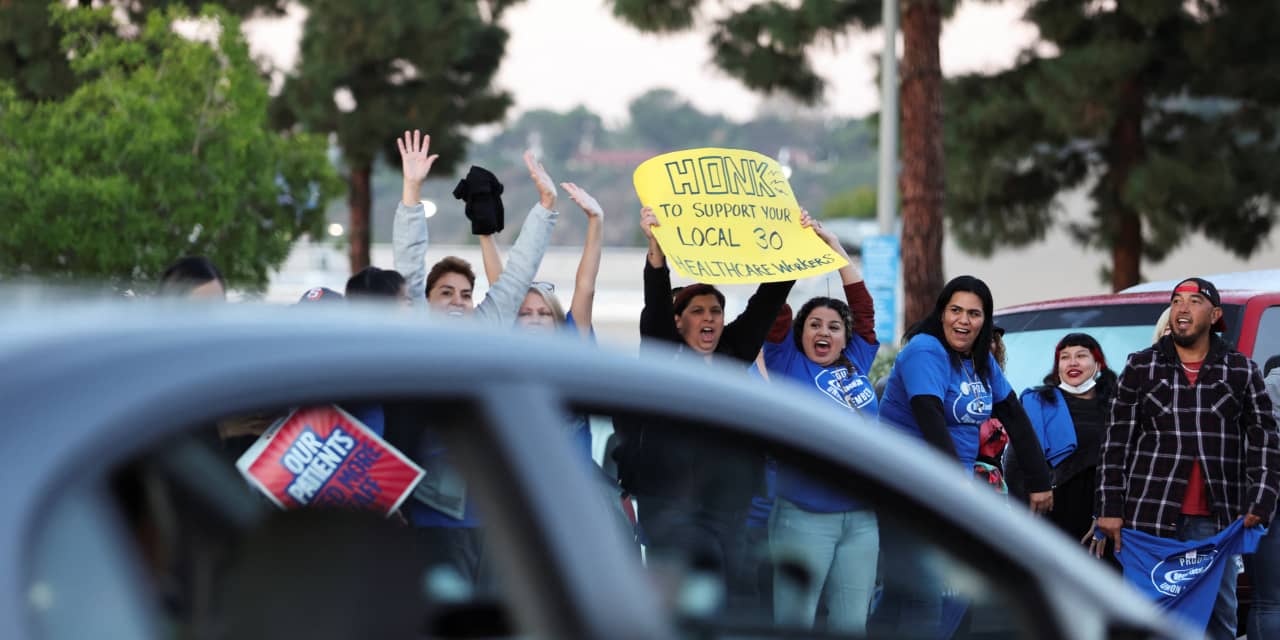
The brief strike launched Wednesday by more than 75,000 workers in the sprawling Kaiser Permanente healthcare system won’t badly hurt other companies right now, but points to potential trouble later this year if the two sides can’t cut a deal.
The walkout, launched Wednesday, will last only until Saturday morning for most of the workers involved, but the unions say they are prepared for another strike in November. Stocks of medical-device makers, whose sales depend on surgeries that could be canceled as a result of the action, lost ground on Wednesday.
Kaiser spokesman Wayne Davis told Barron’s that Kaiser would contact members about “any necessary changes in our services during the strike.” Davis said that those changes “may include rescheduling non-emergency and elective services in some locations out of an abundance of caution.”
The
iShares U.S. Medical Devices ETF
(ticker:
IHI
) was down 1% while the
S&P 500
climbed slightly. Shares of
Medtronic
(MDT) dropped 0.2%.
Abbott Laboratories
(ABT) fell 0.7%.
Experts called it unlikely that the strike will lead to a major hit to the revenue of the medical device makers.
“I would expect the impact on medical device companies, which are probably the most at risk, to be negligible,”
Mizuho
healthcare equity strategist Jared Holz told Barron’s on Wednesday. “If there are a few cases that need to be deferred because of what’s happening over the next three days, those will be recaptured very soon.”
The calculus would be different if the workers walk out again in November. The unions said that a second strike would be larger and longer.
Kaiser said Wednesday that it had been negotiating overnight with the union, and that negotiations were continuing. “There has been a lot of progress, with agreements reached on several specific proposals late Tuesday,” the company said.
The strike is a dramatic show of force by the workers and their unions, and represents yet another sign of swelling pro-union sentiment in the U.S. It follows other major strikes by healthcare workers this year, including one by 7,000 workers at two major New York City hospitals in January, and a continuing action by more than 1,700 nurses in New Jersey.
The Kaiser strike is the largest yet to hit the healthcare sector. Due to Kaiser’s scale, it has more potential than its predecessors to affect the sector’s publicly traded companies. Kaiser, a nonprofit, operates both a health plan and a network of 39 hospitals and hundreds of medical facilities. It says it serves 12.7 million people in eight states and the District of Columbia.
The strike involves workers in five of the states and Washington, D.C. Workers in Virginia and Washington will return to work after one day, rather than three.
The unions called the strike an “initial demonstration of our strength. It comes days after the expiration of the workers’ contract. They are calling for higher wages and an end to what they call chronic understaffing.
“It’s frustrating and painful to watch our patients waiting and suffering while we burn ourselves out trying to do the work of two or even three people trying to care for everyone,” the union coalition behind the strike said in a Sept. 22 statement.
Write to Josh Nathan-Kazis at [email protected]
Read the full article here