




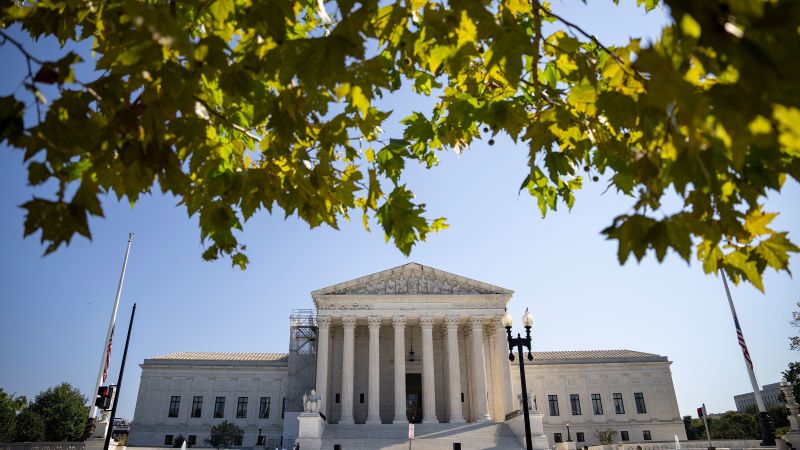
The Supreme Court dodged a major dispute two years ago on the intersection between government officials, social media users and the First Amendment when it dismissed a case concerning then-President Donald Trump’s habit of blocking individuals from Twitter who had expressed their displeasure with him.
The justices ultimately opted out of that dispute because Trump had left office and there was no longer a live case or controversy to decide.
On Tuesday, however, the justices are being forced to take the issue head-on.
At issue before the court is when a government official’s use of social media amounts to a state action that would trigger First Amendment concerns and limit an official’s ability to discriminate on the basis of a commenter’s viewpoint.
Trump is not a party to the cases at hand, but the justices’ ultimate opinion will shape how public officials – from the local level all the way to the White House – use their accounts to communicate with constituents and potential voters.
It’s the first of several important cases on social media at the court.
In the coming weeks, justices will hear a dispute about two state laws that could have nationwide repercussions for how social media companies display user generated content. The court will also consider lower court rulings that severely limit the ability of the White House and others in the Biden administration to communicate with social media companies about content related to Covid and elections the government views as misinformation.
Tuesday’s cases concern two separate disputes targeting the same legal issue, but they feature different facts. In deciding to hear the two cases, the justices may eventually set up a test to determine whether an account is personal and not subject to the First Amendment.
“If a public official uses a social media account as an official forum, whether for engaging with constituents, transacting business, or for other uses related to the office, then they’re a state actor, to whom the First Amendment applies, just as if they were standing at a door deciding who should be allowed into a public meeting relating to their duties,” said Steve Vladeck, CNN Supreme Court analyst and professor at the University of Texas School of Law.
“But just as government officials go home at the end of the day, their social media can also be personal –- to which the Constitution does not and should not apply,” Vladeck added. “The trick in these cases is drawing the line between what’s official and what’s personal, especially for officials who use the same accounts for both.”
In one case, James Freed, a city manager in Port Huron, Michigan, had a Facebook account that was originally private and limited to his personal friends. But the account became so popular that Freed converted it to a public page that anyone could follow. He listed his profile as “public figure” and described himself as: “Daddy to Lucy, Husband to Jessie and City, Manager, Chief Administrative Officer for the citizens of Port Huron.”
The account contained personal details about his life – such as photos of his daughter’s birthday – but also his work in Port Huron. During the Covid pandemic, for example, he shared Port Huron’s policies on public health measures.
An individual named Kevin Lindke objected to the Covid policies and posted his criticism. Freed eventually blocked him and Lindke responded by filing suit under federal law that allows a person to file suit against a state actor when the individual believes his federal rights have been violated.
Lawyers for Freed argue that even though their client was a governmental official, his posts did not constitute state action subject to First Amendment concerns because the social media page was not part of his official duties. A federal appeals court agreed. It held that Freed’s page “neither derives from the duties of his office nor depends on his state authority” and that he did not “fulfill any actual apparent duty of his office.”
“In short,” the panel of judges on the 6th US Circuit Court of Appeals held, “Freed operated his Facebook page in his personal capacity, not his official capacity.” The court said that if Port Huron’s list of city-manager’s responsibilities mentioned operating a Facebook page to tell residents about city initiatives it might be a “different story.”
Another dispute concerns two members of California’s Poway Unified School District Board of Trustees, Michelle O’Connor-Ratcliff and T.J. Zane. They created public Facebook and Twitter pages to inform constituents of what was happening in the district.
But two parents, Christopher and Kimberly Garnier, began commenting on the social media pages with long criticisms of the district. O’Connor-Ratcliff and Zane blocked them, and the Garniers filed suit seeking damages and arguing that the officials’ postings amounted to government action.
The public officials lost at the federal appeals court level.
“We conclude that, given the close nexus between the Trustees’ use of their social media pages and their official positions, the Trustees in this case were acting under color of state law when they blocked the Garniers,” a panel of judges on the 9th US Circuit Court of Appeals held.
The court made clear that although the social media accounts were not required by the trustees’ positions, the accounts were “directly connected” to their jobs. While not every social media account created by a public official is subject to constitutional scrutiny, the court added, “when state actors enter the virtual world and invoke their government status to create a forum” for expression, “the First Amendment enters with them.”
Read the full article here