




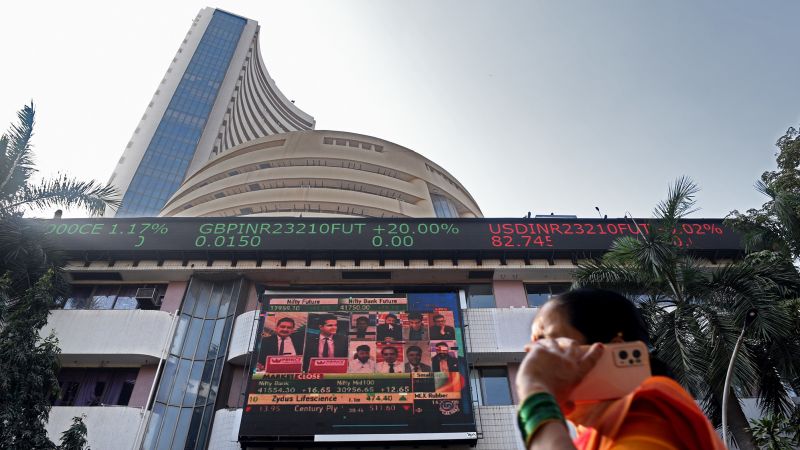
India’s economy is like an elephant. The world’s most populous nation is hard to get moving, but a force to reckon with once in action, analysts often say.
While the global economy has lurched from one crisis to another in recent times, India has shed its lumbering gait and broken into a steady trot.
It began the year by strutting its stuff at the World Economic Forum in Switzerland. Emissaries from India had such a dominant presence at the main street in Davos that one investor described the thoroughfare as “Little India.”
A few months later, as Prime Minister Narendra Modi inaugurated the Group of 20 (G20) leaders’ summit in New Delhi, a first for India, the country’s stock market zoomed to dizzying heights.
The growing economic confidence isn’t limited to earth. In August, India joined the tiny club of countries that have safely placed a spacecraft on the moon, underscoring its scientific and technological ambitions.
The euphoria around India comes at a time when China, which has been the engine of global growth for decades, is seeing a major economic slowdown. Its southern neighbor is fast emerging as a potential successor. From a surging young population to humming factories, the country has a lot going in its favor.
“The Indian economy is undeniably poised for greatness, with a number of reforms undertaken in past years finally paving the way for solid growth,” said Eswar Prasad, professor of trade policy at Cornell University, adding that “the country is receiving considerable interest from foreign investors for at least some good reasons.”
New Delhi also has warmer relations with the West, which views China with growing suspicion, and that means investors now consider the world’s largest democracy a bright spot in an increasingly fractured world.
In the past few decades, there have been other periods of global bullishness about India, but the excitement kept fizzling out, while China raced ahead.
The gap between the two Asians economies is massive. India’s economy is currently worth nearly $3.5 trillion, making it the world’s fifth largest. China’s economy, the world’s second largest, is bigger by almost $15 trillion.
The two combined are expected to contribute about half of global growth this year, the International Monetary Fund has said, with 35% of that coming from China.
To overtake China as the biggest contributor to global growth in the next five years, India must achieve a sustained growth rate of 8%, Barclays analysts wrote in an October report. The IMF projects that India will expand at 6.3% this year.
China, on the other hand, has set an official growth target of around 5%, as it grapples with mounting challenges, ranging from weak consumer spending to a deepening property crisis.
“India’s economy is comfortably placed to grow at an annual rate of at least 6% in the coming few years,” Barclays said. But to achieve the “historically-aspirational” 8% pace of growth, the private sector in India needs to “step up its level of investment,” it added.
The Modi government, which aims to make India a $5 trillion economy by 2025, is certainly laying the groundwork to make it easier to do business and attract more companies to invest.
Much like China did more than three decades ago, India is beginning a massive infrastructure transformation by spending billions on building roads, ports, airports and railways. In this year’s budget alone, $120 billion was carved out for capital spending to boost economic expansion.
The results can be seen on the ground with furious construction underway across the nation. India added 50,000 km (about 31,000 miles) to the national highway network, an increase of 50% in the overall length, between 2014 and 2022.
The Modi government has said the daily pace of national highway construction has more than doubled since it first came to power nine years ago.
India, which has some of the world’s biggest software companies, has also built a range of digital platforms — known as digital public infrastructure — that have transformed commerce.
“Digitization has been a game changer for the country’s citizens and businesses,” said Prasad. “Formalization of the economy has reduced many frictions to doing business and given India’s citizens a sense of being vested in the country’s economic success.”
For example, the Aadhaar program, launched in 2009, has changed lives for millions of Indians by providing them with proof of identity for the first time ever. The world’s largest biometric database now covers most of India’s 1.4 billion people and has helped the government save millions by reducing corruption in welfare initiatives.
Another platform, the Unified Payments Interface (UPI), allows users to make payments instantly by scanning a QR code. It has been embraced by Indians from all walks of life, from coffee shop owners to beggars, and allowed millions of dollars to flow into the formal economy.
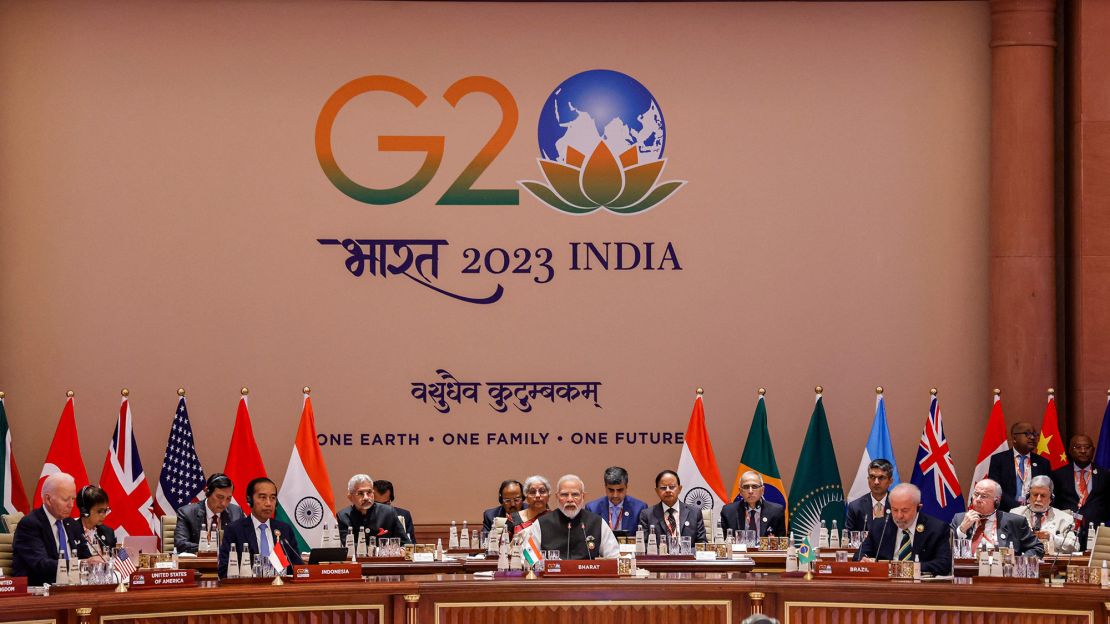
In September, Modi, citing a World Bank report, said that thanks to its digital public infrastructure, “India has achieved financial inclusion targets in just 6 years which would otherwise have taken at least 47 long years.”
Indian companies are getting in on the act. Some of the country’s biggest conglomerates, including Mukesh Ambani’s Reliance Industries and Gautam Adani’s eponymous group, are spending billions on 5G and clean energy, even though they built their empires on the back of traditional industries such as fossil fuels.
India is aggressively trying to capitalize on the massive rethink underway among companies on supply chains. International firms want to diversify their operations away from China, where they faced obstacles during the pandemic and are threatened by rising tension between Beijing and Washington.
Asia’s third largest economy has launched a production-linked incentive program worth $26 billion to attract companies to set up manufacturing in 14 sectors, ranging from electronics and automobiles to pharmaceuticals and medical devices.
As a result, some of the world’s biggest firms, including Apple supplier Foxconn, are expanding their operations significantly in India.
But even as India’s heft is increasing, it is far from recreating the economic miracle China unleashed decades ago.
“India is not like China in the late 1990s and early 2000s in that the government is not clearing obstacles to FDI [foreign direct investments] as quickly,” said Willy Shih, a professor at Harvard Business School.
“I think the perception is different compared to China in the early 2000s — just more bureaucratic, more unpredictability around non-tariff barriers and things that get in the way.”
That unpredictability was on full display in 2016 when Modi suddenly banned most of India’s cash, resulting in long-term pains for citizens and businesses. And, while the country is taking many steps to woo foreign companies, its authorities have cracked down on firms from China.
In an October report by HSBC, economists Frederic Neumann and Justin Feng wrote: “India at the moment runs on too few cylinders to take up the slack from China’s sputtering growth engine,” before going on to highlight the differences in consumption and investment in the two economies.
China accounts for around 30% of the world investment, while India’s is less than 5%. “Even assuming zero growth in China, and a tripling of investment spending growth in India from its recent average, it would take another 18 years before India’s investment spending catches up to China’s,” they wrote.
And it would take another 15 years for India’s consumption to catch up to where China is today in terms of total spending, according to the report.
“Now, none of this is to say that India is not going to have an impact. It will, no doubt — though it won’t be enough to shield the world economy should China’s economy stumble badly,” they added.
Read the full article here