




A version of this story appeared in CNN’s What Matters newsletter. To get it in your inbox, sign up for free here.
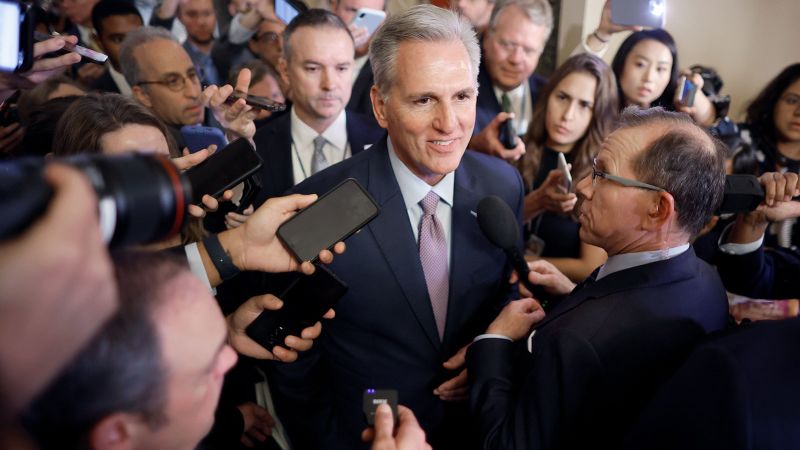
Kevin McCarthy is House speaker no more. After angering GOP hardliners with a spending bill to keep the government funded last week, McCarthy was voted out of power on Tuesday.
Rep. Matt Gaetz, a Florida Republican, filed what in the House is known as a “motion to vacate” and Democrats declined to rescue McCarthy’s speakership. The Californian lost the support of eight Republicans, becoming the speaker with the third-shortest tenure. He said Tuesday evening he wouldn’t run again.
The first “motion to vacate” vote in more than 100 years and the first to succeed, it leaves the House in chaos.
On Tuesday, just before the vote, I talked to Joseph Postell, a politics professor at Hillsdale College, who has written about the so-called Revolt of 1910. He explained how that instance, featuring House Speaker Joseph Cannon, bears some similarity to the ouster of McCarthy, but is also extremely different since Cannon’s job as speaker was never in doubt.
Excerpts of our conversation, conducted by phone and lightly edited, are below:
What’s the difference between what’s happening now and what happened in 1910?
WOLF: Why is this the first time this happened since 1910?
POSTELL: Strictly speaking, this is the first time the so-called motion to vacate or motion to declare the speakership vacant has been brought up … to get a vote on the floor since 1910. … So in that way, this is only the second time this vote has actually proceeded.
WOLF: But Cannon (unlike McCarthy) was never in danger of losing his job, right?
POSTELL: In fact, Cannon actually called for the vote. He was the one who asked for it. That’s the big difference here is that Cannon brought the vote on himself to make the point that the people who opposed him were playing opportunistically. In that way, he actually did it as a sort of principled show of leadership, whereas, obviously, this has been more forced on to (McCarthy). So that is a significant difference.
The broad outlines of what happens in 1910:
There’s a Republican Party, internally divided between progressives and conservatives. So similar, except the lines of division today are obviously very different.
Joseph Cannon was a conservative speaker who basically thwarted the progressive wing of his party, and that wing really couldn’t move to the Democratic Party because in 1910, the Democratic Party was no more progressive than the Republican Party and, in fact, was probably less progressive. So really, all they could do was fight their party from within.
In 1910, the speaker was basically a czar. So really, the difference here, I would say, is that Cannon was a czar and McCarthy is not.
The three pillars of the speaker’s power in 1910 were the right of recognition, the ability to choose all of the chairs and members of committees, and power over the Rules Committee. The speaker doesn’t really have that kind of power today. So progressives could be completely taken out of the policy process.
George Norris, who was a progressive from Nebraska, introduces this resolution to strip the speaker of full control over the Rules Committee. And then, once that passes – it takes three days for that to actually pass – in the next year, they start to strip the other powers of the speaker as well.
So the 1910 debate, and then the vote to vacate Cannon, is really a critical turning point in the whole history of the House of Representatives. It might be the critical turning point in terms of the power of the speaker.
WOLF: Because the speaker lost power?
POSTELL: That was the end of the era of the czar speakers.
WOLF: Have they built it back up in the intervening years? (Former Republican Speaker Newt) Gingrich reclaimed some power and clearly (former Democratic Speaker Nancy) Pelosi exerted more power than a lot of other more recent speakers. Is this a moment for McCarthy to lose some of what’s been built back or something else?
POSTELL: Some of those powers have been returned to the speaker, certainly, over the last 40 years. But my contention is that the speaker hasn’t been returned to any kind of czar power. This episode illustrates that very fact, in part because the motion to vacate is always hanging over the speaker these days. It certainly hung over (John) Boehner’s head and over Paul Ryan’s head, and then McCarthy. I think we are still living in this world of weak speakers, even if some of those powers have been clawed back. That’s a little bit of a point of contention, probably, between me and other scholars.
WOLF: I’ve read your argument that the speaker should be more powerful. Explain that.
POSTELL: I think that the American Congress is designed to be gridlocked, fragmented and very difficult to assemble a majority. That is the basic insight of Federalist Number 10, which is probably the most famous of all the Federalist essays, is that we want we want a Congress that is going to be fragmented and gridlocked.
The problem with that is how do you actually ever assemble a majority coalition and then get the members of that coalition to vote together on some sort of agenda? The only way, it seems to me, that you can get there in the modern context is to have parties that are able to build those coalitions, to maintain them, and to have leaders that lead the party on behalf of the party to govern effectively. I think that would enable Congress to take more power from the executive branch, it would enable Congress to get more done and it would also incentivize bargaining and compromise across the two parties because the incentives of the party leaders are to govern, rather than the individual members of Congress, which are to campaign and fundraise and to make displays even if you’re not doing serious legislative work.
Republicans and Democrats are vastly different than they were in 1910
WOLF: You pointed out that in 1910, it was similar in that there was a Republican majority divided in two. How are the parties different than they were back then? They have realigned so completely that I’ve heard it said that Republicans of then are more like Democrats of today. Do you agree with that?
POSTELL: To some extent, although I think the issues are so different these days that it’s hard to draw really those kinds of connections.
I think the big difference between the parties in the early 20th century as opposed to today is that the older parties during Cannon’s day were much stronger. They had access to patronage. They had access to more campaign finance that was directly tied to the parties rather than to independent groups. They also were able to control the nominations of their congressional candidates. So the parties were actually much stronger a century ago.
Today, the parties don’t have nearly as much control over campaign finance or over nominations. And so that’s one reason why the speaker is so much weaker these days than in Cannon’s day.
WOLF: How do you think Cannon would view what’s happening to McCarthy?
POSTELL: I think Cannon would probably encourage McCarthy to be bolder, and to accept that defeat is a realistic possibility and to be ready to retire from public life…
Cannon, when he risks it all in 1910, he’s perfectly calm about it because he doesn’t see his political career as being everything to him. He’s more than happy to retire from public life, to make money in the private sector. One of the things about those politicians of that day is that they were prepared to stake their careers in order to make a principled stand. And then they accepted the results. They didn’t see a life outside of politics as a sort of sentence. They were willing to be more bold. McCarthy, I think, probably from Cannon’s point of view, has played too defensively.
WOLF: If you look back at the recent Republican leaders and speakers, the same issue has ended all of their tenures. It’s like history repeating itself. This is the first time this kind of vote has removed a speaker, but it’s always their inability to control the Freedom Caucus wing that’s ousted them. How should Republicans be dealing with that?
POSTELL: It’s not easy to answer that question because it is hard to know what Republicans can do to deal with it.
The question implies that (they) have some means or ability to control what’s going on. And there are things the parties could do. You could try to encourage candidates in primary races that are more open to compromise, that are more open to working with the rest of a coalition. That’s one thing they could do. But they don’t have the resources to control a lot of those races or to make much of a difference. So really, it’s hard to see what the Republicans can do.
If you were thinking longterm about this problem, which might be the best way to think about it, you would try to rebuild the party.
As a long-term project, it means really focusing on rebuilding your state parties so that your parties feel more connected to the base. Because I think what’s really given rise to this problem is that many members of the Republican base don’t feel like the party represents them.
WOLF: As we’re talking (before Tuesday’s vote to oust McCarthy), we don’t we don’t know his fate. But where do you place his very short speakership right now in the in the pantheon of House speakers?
POSTELL: I think he’s done an admirable job in a very difficult position. He has decentralized a lot of the authority. He put people on the Rules Committee who were friendlier to the Freedom Caucus. More than Boehner or Ryan, he showed a willingness to work with the Freedom Caucus. Obviously, he had to do that. But I think he’s followed through on a lot of his promises, and so I would say he did an admirable job in very difficult circumstances with the situation that he was put into.
Read the full article here