




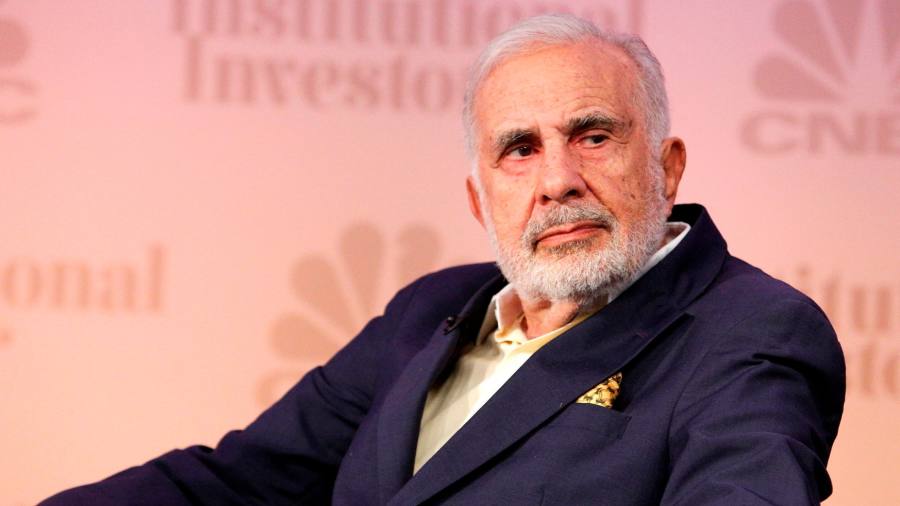
Carl Icahn has admitted he was wrong to make a huge bet that the market would crash after the ill-fated trade cost his firm nearly $9bn over roughly six years.
According to a Financial Times analysis, the prominent activist investor lost about $1.8bn in 2017 on hedging positions that would have paid out if asset prices had tumbled before losing a further $7bn between 2018 and the first quarter of this year.
“I’ve always told people there is nobody who can really pick the market on a short-term or an intermediate-term basis,” Icahn told the FT in an interview to discuss the analysis. “Maybe I made the mistake of not adhering to my own advice in recent years.”
Icahn Enterprises started aggressively betting on a market collapse in the aftermath of the 2008 financial crisis and became increasingly bolder in subsequent years, deploying a complex strategy that involved shorting broad market indices, individual companies, commercial mortgages and debt securities.
At times, Icahn’s notional exposure, the underlying value of the securities he was betting against, exceeded $15bn, regulatory filings show. “You never get the perfect hedge, but if I kept the parameters I always believed in . . . I would have been fine,” he said. “But I didn’t.”
Icahn Enterprises, the listed vehicle majority owned by the activist that allows retail investors to join in his wagers, reported a total of $4.3bn in short losses in 2020 and 2021 as markets quickly rebounded from the pandemic slump following the Federal Reserve’s huge stimulus.
“I obviously believed the market was in for great trouble,” said Icahn. “[But] the Fed injected trillions of dollars into the market to fight Covid and the old saying is true: ‘don’t fight the Fed’.”
The trades have left Icahn in a vulnerable position and threaten to undermine his status as one of the most feared activist investors on Wall Street.
Earlier this month, short seller Hindenburg Research released a report saying it believed the market value of Icahn Enterprises was inflated and its dividend was unsustainable. Shares of the company have fallen by more than 30 per cent since the report was published.
As Icahn’s short bets drained billions of dollars from his investment firm, he ploughed nearly $4bn of his own money into his publicly listed vehicle, filings show. That injection helped keep the firm’s internally calculated investment portfolio value relatively stable.
Icahn exposed himself to another risk by taking out a margin loan that was first disclosed in early 2022. Hindenburg’s report drew attention to the margin loan from Morgan Stanley, against which Icahn pledged 60 per cent of his stake in Icahn Enterprises as collateral.
Hindenburg argued this could lead to his business unravelling if the plunging stock price triggers a margin call that would force Icahn to liquidate some of his stake.
In a statement earlier this month that addressed Hindenburg’s allegations, Icahn Enterprises said Icahn was in “full compliance” with regards to all personal loans and announced a $500mn stock buyback authorisation in a bid to bolster its share price. With regards to its market valuation, the company said that “over time, [our] performance will speak for itself”.
Icahn told the FT that he had used the margin loan to make additional investments and had billions of dollars of cash outside of his public vehicle. “Over the years I have made a great deal of money with money,” he said. “I like to have a war chest and doing that gave me more of a war chest,” he added, referring to the margin loan.
Icahn Enterprises has warned that “a prolonged decline” in its stock price “could increase the likelihood of a foreclosure or forced sale” of Icahn’s stake if he was “subject to a ‘margin call’”.
Earlier this month, Icahn Enterprises revealed federal prosecutors in New York had contacted the company seeking information on its business, including corporate governance, valuations and due diligence.
Icahn’s bearish bets are the main reason his investment portfolio has lost money in every year since 2014. Over the roughly six year period that he lost $9bn on the short bets, the portfolio made about $6bn from his activist wagers, leaving the vehicle with an overall investment loss of nearly $3bn.
Separately, Icahn Enterprises generated $3.5bn of gains during the period by selling companies it controlled — including casinos and a railcar leasing business — that were held outside the investment portfolio.
The net asset value of Icahn Enterprises fell from $7.9bn in 2017 to $5.6bn this month. That poses a potential problem for Icahn, who has historically taken the large $8 a share annual dividend in stock rather than cash. This has caused the number of outstanding shares to more than double over the roughly six-year period, pushing its net asset value per share down from $33 to roughly $16.
Retail investors who took their dividends in cash would have received more than $40 a share during the same period.
As pressure on his firm mounts, Icahn has been forced to rein in his short bets just as some investors fear that a regional banking crisis and the debt ceiling stand-off could result in a sharp market sell-off.
“I still to some extent believe that this economy is not good and there are going to be problems ahead,” Icahn said. “We are still hedged, but not to the extent we were.”
Read the full article here