




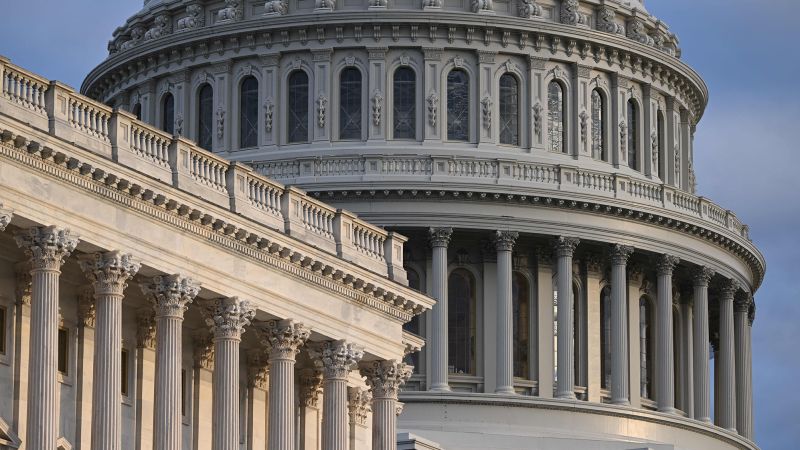
If you want to aggravate the US bond market, just remind traders how high the nation’s budget deficit is.
The latest tally from the Treasury Department for the fiscal year that ended September 30 put the deficit at $1.7 trillion.
But it’s effectively even higher — around $2 trillion — if the impact of President Joe Biden’s federal student debt cancellation plan, which the Supreme Court struck down before it took effect, is not included. That’s twice as high as the deficit the prior fiscal year.
Budget deficits happen when a government’s spending exceeds what it collects in taxes. To cover the difference, governments have to borrow money, which usually comes from issuing more bonds. All else being equal, that tends to push bond prices down, which causes yields to go higher.
For a while, investors shrugged off the ever-growing US deficit and the impact it has had on the government’s debt obligations, since the understanding has been the Treasury will make interest payments on time.
But, increasingly, investors are paying more attention to policies that have the potential to further increase the deficit and the amount of money the government has to borrow. That has led more investors to question how sustainable the debt level is and, as a result, demand higher compensation for holding long-term debt, said Lisa Shalett, chief investment officer at Morgan Stanley Wealth Management.
Treasury Secretary Janet Yellen, however, said she doesn’t think “much of” the rise in yields is connected to the US budget deficit. “Largely, I think it’s a reflection of the resilience that people are seeing in the US economy,” she said on Thursday at an event hosted by Bloomberg.
Meanwhile, lawmakers have yet to sign off on a budget for most of the current fiscal year, but the possibility of having to fund two simultaneous wars, in Israel and Ukraine, would undoubtedly lead to more government spending and a higher deficit.
What will that mean for the bond market?
Ramping up spending to support Israel and Ukraine doesn’t automatically mean the deficit will grow and cause bond yields to move higher, said Rachel Snyderman, director of economic policy at the Bipartisan Policy Center.
The defense spending proposal Biden unveiled last week that allocates $86 billion for Ukraine, Israel and humanitarian aid in Israel and Gaza “would comprise a significantly small portion of the deficit,” Snyderman told CNN.
The Treasury would need to issue more bonds to come up with the $86 billion, she said. But that would represent three-tenths of a percent of the $26.33 trillion of US debt held by the public.
By her own calculations, it would increase the deficit in the 2024 fiscal year by just 5% from the Congressional Budget Office’s projected deficit level of $1.57 trillion for the current fiscal year.
During previous periods of heightened geopolitical tensions such as wars, investors tend to stage a flight to safety, including moving more of their money towards assets like US Treasury bills that are viewed as safe havens.
That initially happened when the war broke out in Israel, causing yields to fall. But yields quickly bounced back. For instance, the yield on the 10-year Treasury note is almost touching 5% for the first time since 2007.
That suggests there are other factors that may be outweighing the effects of the war that are driving yields higher, said Snyderman.
Over the past few months, investors have come to terms with the prospect that interest rates could remain higher for longer than they initially expected when the Federal Reserve began tightening last year.
That’s because inflation remains above the Fed’s 2% target, and recent data shows it’s heating up again. To get inflation down more, Fed officials have been signaling that they’ll need to keep rates near current levels until they’re convinced inflation won’t run hotter.
In anticipation of the “higher for longer” phenomenon, investors have been selling more US bonds.
Since the debt ceiling was suspended in June, the Treasury has been issuing more bonds to fund government spending.
Also, since the debt ceiling was suspended in June, the Treasury has been issuing more bonds to fund government spending, pushing bond prices down.
The Treasury warned in July it expected to borrow $1 trillion in the third quarter, the most the government has ever borrowed during a third quarter. On top of that, Treasury estimates it will borrow $852 billion in the final quarter of this year. However, that estimate doesn’t take into account the war between Israel and Hamas.
Another factor that could be playing a role is Fitch Ratings’ recent downgrade of US debt and Moody’s Investors Service warning that it could revise its assessment of the fundamentals that dictate its credit rating for the United States.
Taken together, both are signaling to investors that holding US debt is riskier, said John Lynch, chief investment officer at Comerica Wealth Management.
Even if US spending to support Israel doesn’t directly impact bonds, “the uncertainty that wars inject into the economy” is enough to throw markets off course, said Snyderman. That makes it particularly difficult to predict the future path of bonds, he said.
Read the full article here